
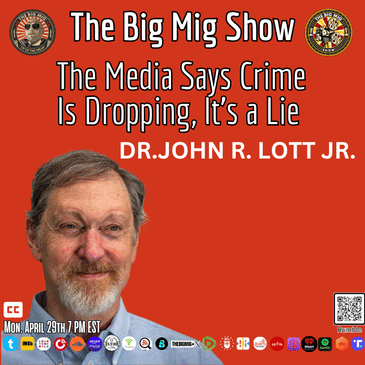
[00:00:00] All men are created equal, but they are endowed by their creator with certain unalienable rights.
[00:00:09] By Liberty and the Beauty Club
[00:00:13] If Liberty means anything at all, it means right to tell people what they do not want here.
[00:00:30] Make America Great Again
[00:00:38] The Big Mig
[00:00:43] Welcome back to The Big Mig Show. I am your host Lance Miliaccio, of course with my co-host George Valentin,
[00:00:50] Ever Vigilant working away. We are the tip of the spear.
[00:00:53] Liberty means anything at all, it means the right to tell people what they do not want to hear.
[00:00:58] That is what we do each and every episode. We bring you the facts, the proof, the source, the receipts, the right guests,
[00:01:05] and hopefully through that education our plan is to unify the country.
[00:01:09] We hope that you are going to get the real information, not the BS at the mainstream media or our own deep state government feeds you.
[00:01:17] But in fact the real truth tonight isn't going to be any different. We have a great guest tonight.
[00:01:21] But first I want to thank our sponsors, CFMud.com, Patriotic Apparel for the whole family.
[00:01:27] We appreciate them. Don't forget to use all caps of The Big Mig for the best deal and of course BeardVet Coffee, BeardVet.com.
[00:01:36] Same thing, The Big Mig All Caps will get you the best deal. Don't forget BeardVet Tactical and of course BeardVet Energy,
[00:01:43] fantastic product. Everybody that's bought it is just raving about it. You can add it to any other thing you're drinking.
[00:01:48] It's just darn near flavorless. And of course I want to thank Original Glory.
[00:01:57] They came back on board, they did some rebranding. Ladies and gentlemen, meet the original Glory American Pillsner,
[00:02:03] the beer that embodies the American dream with its crisp refreshing taste and bold free spirit.
[00:02:09] It's the perfect companion for any occasion and obviously made with the finest American hops and barley.
[00:02:14] This beer is a true taste of freedom. So grab a cold one. You know it's coming up, the summer's going to be hot.
[00:02:21] And toast to the land we live and love with beer. That's as American as it gets.
[00:02:26] And let me tell you something that's a great company, non-woke, obviously still fall out going on from Budweiser.
[00:02:33] Here's your substitution. And of course this time around they also came up with a light beer product.
[00:02:38] So for you guys that are counting calories, it's a great product. We appreciate their support for the Big Make Show.
[00:02:44] You're going to see more of them. We'll be doing some giveaways and other things with them. Pretty excited.
[00:02:49] So tonight you guys have all been questioning it across the country. I've been questioning it.
[00:02:55] They keep telling us statistically that crime is down across the country.
[00:03:00] The numbers they're providing us allegedly report that.
[00:03:04] The expert and funny both the left and the right say he's the expert.
[00:03:10] Dr. John R. Latt Jr.
[00:03:14] He's an American economist, political commentator and gun rights advocate.
[00:03:19] No.
[00:03:21] It sounds like you're reading from Wikipedia.
[00:03:25] It may be. You know, Dr. Lott, we never got an email from you.
[00:03:29] There's no reason to actually do that.
[00:03:33] Come on in. We'll let you tell people what your bio is and I apologize. We never got an email from you.
[00:03:38] Okay. All right. Well, we can talk later.
[00:03:41] Well, let's go ahead and do this. Let's let's start. Dr. Latt. I want to introduce to the audience.
[00:03:46] Can you go ahead and give him some background on yourself just so we don't give him the wrong information?
[00:03:51] Because we obviously do not want to do that, sir.
[00:03:52] Well, I'm an economist, a PhD in economics from UCLA.
[00:04:00] I've had research and teaching positions at Stanford University of Chicago Yale, the Wharton Business School.
[00:04:07] I was chief economist for the United States Sentencing Commission.
[00:04:11] And I was more recently senior advisor for research and statistics at the U.S. Department of Justice.
[00:04:16] First in the Office of Justice Programs and then the Office of Legal Policy.
[00:04:20] And I'm also the president of the Crime Prevention Research Center.
[00:04:26] And also proficient author. 10 books, correct?
[00:04:30] Right.
[00:04:32] And obviously you have been putting out information that in fact disproves the information that's coming out of D.C.
[00:04:41] Looks like you've had some great compliments even from the left Newsweek called you the gun crowds grew.
[00:04:47] Yeah, I'm not sure they did that in a positive way. But anyway, so right.
[00:04:58] Well, I mean, so there are lots of headlines right now saying that violent crime is falling and people will point to the FBI uniform crime reports.
[00:05:10] And that's correct.
[00:05:12] Problem is there are two different measures that exist on crime.
[00:05:16] There's the FBI crime reports, which just kind of count up the number of crimes that victims report to police.
[00:05:23] And then also.
[00:05:26] And also the National Crime Victimization Survey data, which surveys about 240,000 people each year
[00:05:33] in order to try to find out who has been victims of crime, the rates, very detailed questions that they get asked about the characteristics of the criminal.
[00:05:43] What occurred when it occurred where it occurred.
[00:05:47] And what they did in response and what the final outcome was.
[00:05:53] And what you find is that the that data goes in since 2020 has been going in the opposite direction of the reported crime data.
[00:06:04] So the difference between the two is for a long time, academics and people dealing with crime have noticed that most crimes aren't reported to police.
[00:06:16] And so you can't just look at.
[00:06:19] You just can't look at the.
[00:06:22] You just can't look at the crime numbers from the reported you have to go and and try to figure out the rate of non reported crimes.
[00:06:35] And that's what the National Crime Victimization Survey does.
[00:06:40] And what you find is that while there's been a drop in the FBI reported crime numbers, there's been a huge increase in total crimes.
[00:06:49] So if you look at the difference between 2021 and 2022, while reported violent crimes to the FBI fell by about 2.3%, there was at the same time a 42% increase in total crimes as given by the National Crime Victimization Survey, which is unbelievably huge increase.
[00:07:13] So the question is why are these numbers going in opposite directions?
[00:07:17] And the answer is pretty simple that.
[00:07:22] Well, there are a few reasons for it, but I think the main one is that law enforcement in this country's fallen apart.
[00:07:31] And that because of that people don't have the same incentives or desires to report crimes to the police as they did before.
[00:07:39] So I'll give you a couple of simple examples.
[00:07:42] If you look at large cities over a million in population, for example, but this is true across all cities.
[00:07:51] In the five years before COVID there was a risk rate for violent crimes of 44%.
[00:07:57] And they in the 2020 and started to fall.
[00:08:02] And then by 2022 it had fallen even more.
[00:08:06] It had gone down to 20%.
[00:08:08] So you ended up going from a risk rate of 44% of violent crimes to 20%.
[00:08:15] That's over 50% drop.
[00:08:17] That's a huge drop.
[00:08:19] We've never seen anything like that before, let alone over decades, let alone over a few year period of time.
[00:08:26] And the drop in property crimes is even larger.
[00:08:30] But again, this is arrests of relative to reporter crimes.
[00:08:35] If you were to go and look at the numbers for arrests compared to all violent crimes, it's about 8%.
[00:08:41] And if you were to look at arrests for all property crimes, it's like 1% of all property crimes result in arrest.
[00:08:49] And of course just because somebody's arrested doesn't mean that they're going to be charged.
[00:08:53] It doesn't mean even if they're charged, it doesn't mean that they're going to be prosecuted.
[00:08:56] Even if they're prosecuted, it doesn't mean that they're going to end up being convicted.
[00:09:03] And so you have a very tiny percent of criminals, either violent and even an infinitesimal percentage of those engaged in property crimes that are going to face any type of punishment.
[00:09:17] And so that's done a couple of things.
[00:09:20] One is it's resolved to more crime because it's not risky for criminals to go and commit crime.
[00:09:26] At the same time, victims don't see much point or some of them don't see much point in going reporting crimes to the police.
[00:09:36] And you see this in many different ways.
[00:09:38] There are police departments around the country.
[00:09:41] If you call in a dispatcher, we'll ask you if there are criminals there.
[00:09:46] If the criminal is not there, they won't even bother to send out police.
[00:09:49] They'll tell you you have to come in to a police station to fill out a report.
[00:09:55] You make it difficult and costly for the victims to go and report crimes.
[00:10:00] They're not going to report crimes as frequently as they did before.
[00:10:03] And also many times people will be told that nothing's going to happen.
[00:10:08] They're not going to catch them.
[00:10:10] So when is that going to cause people to create for people to go even and bother reporting crimes?
[00:10:16] And so it's pretty simple what's happened.
[00:10:19] Has there been a drop in reported crimes according to the FBI?
[00:10:21] Yeah. And that's what the media uses all the time.
[00:10:25] But it's not very useful to understand that because the reason why there's been a drop in reported crimes is because law enforcement's fallen apart and so people don't see much point in going and reporting them.
[00:10:40] It's not because crimes fall and crimes increasing.
[00:10:43] You can see a trend on social media.
[00:10:46] People are disappointed with the results of the crimes that report.
[00:10:51] It's an ongoing thing that we see on all platforms that people have reported a crime and law enforcement's response was lackluster.
[00:10:59] And that's probably giving them a benefit of the doubt.
[00:11:02] In fact, like you just said many of the many of people that report a crime say that the law enforcement never even shows up.
[00:11:08] They file feel like they're on their own.
[00:11:10] This is a trend across the United States and there's no doubt.
[00:11:12] You know, the question that always comes up at least in all the groups who are in and obviously on our show regularly is is is their intentional?
[00:11:22] Is this intentional?
[00:11:24] Is the FBI and the news are they aware of the fact that they're under reporting the true numbers of violent crime?
[00:11:30] What do you think?
[00:11:32] I mean the FBI has had their data for 80 years or so.
[00:11:36] And so, you know, the National Crime Victimization Survey was set up about 50 years ago in order to try to get a measure of unreported crime.
[00:11:52] You know, this isn't a survey of a thousand people or 5,000 or 10,000 or even 20,000.
[00:11:59] This is a survey of 240,000 people and they asked some very detailed questions to try to get a measure of unreported crime.
[00:12:06] They wanted to make sure that they're honestly answering these questions and they are trying to find out have you been a victim of a crime or not.
[00:12:17] And then they go and they try to use that to figure out what the national rates are there.
[00:12:22] But the whole reason why it was set up and the whole reason why people rely on it is because we need to have some measure of total crime there.
[00:12:30] And academics and researchers have long known that the FBI data doesn't tell you that.
[00:12:38] It just tells you reported crime.
[00:12:41] But the problem is that usually in the past there's been some relationship, a reasonable relationship between the FBI reported crime data and total crimes.
[00:12:54] But since 2020 they've actually been negatively related to each other.
[00:13:00] Increases in the one has been associated with drops in the other one.
[00:13:04] So, you know, then you have to explain it and there's other issues with regard to the FBI data starting in 2021.
[00:13:14] They changed the system for reporting.
[00:13:17] Went to a system called Nibus and over 30% of police departments have stopped reporting their crime data to the FBI.
[00:13:28] Now that doesn't mean that they put zeros in there for them.
[00:13:32] They go, the FBI then tries to estimate what their reported crime numbers would be.
[00:13:38] Now their problems with that and I'm not sure that they're doing a particularly good job of that.
[00:13:43] Second problem at least has been reported, though I haven't been able to get an answer yet on what's going on is that a number of cities that have reported crime data to the FBI.
[00:13:57] The numbers that they give to the FBI because the FBI doesn't go and figure this out on their own.
[00:14:03] They depend upon local police departments around the country to provide them with the data.
[00:14:07] The numbers that the FBI says that they're getting from these cities is less than what these cities say that they're giving to the FBI.
[00:14:16] And can I stop you there for a minute? I found a statistic. I don't know if it's accurate in 2022 31% of police departments nationwide.
[00:14:24] This included Los Angeles, New York didn't report crime data to the FBI.
[00:14:29] And in fact, in addition to that, it appeared as though they were reporting under counting those crimes.
[00:14:34] Do you think that's politically driven and do you think that number is accurate? That's 2022 I couldn't find 2023.
[00:14:40] So maybe you have that information.
[00:14:42] Well the 2023 numbers aren't out, but no, I mean it sounds like you're reading from my op-ed in the Wall Street Journal there that I had.
[00:14:50] And yeah, I mean that's correct.
[00:14:53] I mean 2021 it was even worse. It was about 37% of police departments.
[00:14:58] But you have a lot of large police departments that aren't doing it.
[00:15:03] They have this data.
[00:15:05] It's not a, you know, could be political why they're not reporting it.
[00:15:09] But again, these numbers don't go in a zero then into the FBI counts.
[00:15:15] The FBI tries to estimate these things.
[00:15:18] But you know there can be real issues with how they're estimating them.
[00:15:22] And what I can tell you is that people put a lot of weight on the national crime victimization data.
[00:15:32] And it's at odds, radically, dramatically at odds with the FBI data.
[00:15:40] Even the estimates from the national crime victimization data on reported crimes doesn't match up with the FBI data on reported crimes.
[00:15:50] And so that raises questions about their estimates and other things that the FBI is doing.
[00:15:56] Do you feel like that you see any kind of a pattern?
[00:15:59] Is there any differentiation between blue states and red states that one or the other is reporting less or trying to maybe massage the numbers in a more proactive way so the appearance is that they're actually better numbers than what's actually really going on.
[00:16:13] Do you see any pattern that's politically motivated?
[00:16:17] There are a lot of places in California.
[00:16:20] California seems to be disproportionately not reporting these types of numbers.
[00:16:25] But you know, these decisions to report are basically a local decision.
[00:16:33] Local police departments are making these decisions.
[00:16:36] And it's not so much a blue or Democrat or Republican state issue.
[00:16:40] It's the, you know, you have, even in Republican states, you'll have heavily Democratic areas and vice versa.
[00:16:52] And so I think it's much more reasonable to kind of think about this as a local issue that's going on.
[00:16:59] And at least it appears that it's primarily Democratic jurisdictions, police departments that aren't reporting this type of data, particularly many of the larger ones for sure are Democratic ones.
[00:17:14] Well, Lance, I could say it's being from like the town I'm from and surrounding towns.
[00:17:18] I know they don't report crimes because they don't want the property values and to go down or have any negativity for the town when people are looking to search and to buy homes.
[00:17:30] I know that for a fact.
[00:17:32] And it's the town I'm in is Republican town.
[00:17:35] So yeah, I don't think there's any discrimination.
[00:17:37] George is located in New Jersey and his uncle is very well connected politically.
[00:17:41] So he gets a lot of details from the New Jersey government or some of the things that we talk about on the show.
[00:17:45] So I don't know if that makes any sense.
[00:17:48] Well, I mean, yeah, I don't know.
[00:17:56] It's, yeah, I'm not sure I have anything to comment on that.
[00:18:03] Well, I guess have you found any, I guess what George is suggesting there is intentional under reporting obviously for the optics of a certain town or city.
[00:18:11] Do you feel like you've come across that?
[00:18:13] And have you had any pushback as you've been doing your research that you've had people that you've tried to get the information from and they push back?
[00:18:21] I mean, it's still public on these cities.
[00:18:23] I mean, what I was trying to say before was that, you know, you could go to Los Angeles website and go to New York and go to other cities.
[00:18:32] They still have this data.
[00:18:34] So just because it's not reported to the FBI, the FBI is still going to put numbers in there.
[00:18:39] So I guess, I mean, I guess if you hope that the FBI underestimates what your crime is and people only go to the FBI and don't look local people aren't going to go and look to see what the crime numbers are in a particular place or the news.
[00:18:53] You know, so if you have murders that occur in a city and at the end of the year, you know, the local newspapers and whatever can go and look to see how many murders occurred in the city.
[00:19:04] It's not whether that number got reported to the FBI or not is going to matter in terms of local property values.
[00:19:12] We were just at an event out in Las Vegas with the CSPO, which is the Constitutional Sheriffs Association.
[00:19:19] And we did a bunch of independent interviewing with sheriffs from all around the country.
[00:19:24] The report we're getting is that they are seeing a very large increase in crime and especially violent crime.
[00:19:32] They're connecting it to the border invasion, you know, not knowing where the numbers going to end up for 24 and obviously at the end of 23.
[00:19:40] Do you see a similar pattern as they reported to us because they're convinced that the border invasion and the fact that we are not protecting our border and we're allowing these individuals come in.
[00:19:50] Most of them unvetted. A lot of them being dumped out of jails and prisons from other countries and brought to our border by NGOs and other organizations.
[00:19:59] Do you feel as though that that that's a correct statement by them?
[00:20:03] You're starting to see a pattern where there's even a larger rise that we're going to be seeing here in the short term future.
[00:20:09] I think there's plenty of evidence that illegal immigrants commit crimes that relatively high rates.
[00:20:16] I think legal immigrants commit crimes at relatively low rates compared to the native population.
[00:20:23] But look, I mean, we've had, I don't know, at least as of a couple months ago, something like 8 million legal immigrants who turned themselves in.
[00:20:34] You have another 1.8 million or so, so-called God a ways people who we saw coming across but we weren't able to catch.
[00:20:45] And then we have an unknown number of illegals that we never saw coming across the border.
[00:20:53] And my orcas and recent testimony before Congress indicated that, or at least help confirm that a lot of the electronic surveillance stuff that we have on the border may not been operating all the time.
[00:21:08] He wasn't going to say how often it wasn't operating.
[00:21:11] And also you have something like 90% of the border agents that would be normally monitoring the border are have been taken away to do processing for the illegals that are coming in.
[00:21:26] And so there's large portions of the border where nobody is watching.
[00:21:30] And so we have no clue how many millions more might have come in through that.
[00:21:36] I mean, there could be a lot more that have come in that we can't monitor.
[00:21:41] And so, you know, I have no idea how many more than 10 million we have, but it's something obviously north of 10 million as of a couple months ago.
[00:21:51] And, you know, I've no problem believing that you're going to have a significant number of criminals that are there.
[00:21:59] And in terms of violent crime.
[00:22:01] Well, there's no doubt we've had reports we deal with Oscar L. Blue Michael Yon and Van der Steele Ben Berkman people around the border nonstop and have been reporting from the border right now.
[00:22:13] The influx of transnational gangs has been proven.
[00:22:17] The sheriffs that we were talking about have confirmed that these are organized gangs that are running around the country and committing crimes.
[00:22:23] I don't know how much of that's getting reported or not reported.
[00:22:26] The NFSC is another group we work with directly the new federal state of China.
[00:22:30] They've reported that we have eight different divisions of Chinese military in the country.
[00:22:35] They're using safe houses at a lot of the farmland properties around the country.
[00:22:39] So you're talking about some pretty organized systems.
[00:22:41] The cartels have had a banner year financially in the last 12 months.
[00:22:46] And I'm not doing that annually.
[00:22:48] I'm saying for the last 12 months they've made a tremendous amount of money.
[00:22:51] They're human trafficking and obviously has been a huge funding source.
[00:22:54] You can see it because the sophistication of the cartels has gone through the roof.
[00:22:59] They're buying weapons out of South Africa.
[00:23:02] They've been buying a lot of the weapons and they found them, for example, recently there was some seizures of some quad mono goggles, which are night vision systems.
[00:23:11] The cost of US government $60,000.
[00:23:14] The serial numbers on the three that were grabbed, they came out of Afghanistan.
[00:23:18] So they're obviously buying items on the dark web.
[00:23:21] And if you see these cartels nowadays, they're armed as though they're special forces teams.
[00:23:27] So they've got a VIP system that we've had confirmed from sources that allows people to have anything in the interpole database or criminal database to get VIP access using tunnels at a higher rate than the normal rate they charge.
[00:23:39] Ben Berquem has a bag of IDs.
[00:23:42] I checked with him the other day.
[00:23:44] It's 108 countries worth of IDs that have been dumped on the other side of the border.
[00:23:48] These people are coming in and alleging they're from one country or another and they can't vet them because of the sheer quantity.
[00:23:53] Border Patrol, Sonia Lobosco tells me that the majority of our US air marshals have been pulled off flights and they're being put down at the border and they're making sandwiches for illegal immigrants.
[00:24:04] And we've seen what's going on with the NGOs on the other side of the border and the Darien Gap.
[00:24:07] So there's no doubt that I believe the trend is going to be an uptick.
[00:24:11] We're going to end up taking a short break here, Dr. Lott.
[00:24:15] And when we come back, what I'd like to cover is you've always been a pro gun advocate.
[00:24:20] I'd like to hear the impact of 2A on hopefully stopping the staunch of these violent crimes and your input on why it's so important.
[00:24:28] All right, we'll be right back in a few minutes. Stay tuned.
[00:24:33] If we lose freedom here.
[00:24:36] There is no place to escape to. This is the last hand on earth.
[00:24:42] You're up for your toughest jobs or your most rugged excursions. Introducing Sea of Mud Apparel.
[00:24:54] Your go-to destination for clothing that embodies the relentless spirit of rural America.
[00:25:00] We were blue collar before it was cool to say you work for a living.
[00:25:04] Let your clothes speak for you, embrace quality, comfort and the American way.
[00:25:08] Shop now at SeaofMud.com
[00:25:38] Vet founded, vet focused and beard operated.
[00:25:42] This is coffee with a mission, a purpose and a testament to the unyielding American spirit.
[00:25:48] It's a tribute to the tireless resolve that courses through the veins of our great nation.
[00:25:53] This is the taste of victory, the flavor of freedom, the coffee that stands as firm as our belief in America's destiny to lead.
[00:26:02] And never to new, Beard Vet Coffee is more than a brand.
[00:26:05] It's a legacy steeped in the principles that make America great.
[00:26:09] It's for those who stand with pride under the stars and stripes,
[00:26:13] who uphold the values that light the torch of liberty for the world to see.
[00:26:18] So are you ready to supercharge your day the American way?
[00:26:22] Beard Vet Coffee is not just a choice.
[00:26:25] It's a declaration of independence from mediocre mornings.
[00:26:28] Bold, brave, unbound, brood for the American patriot.
[00:26:32] Beard Vet Coffee. Make your mornings great again.
[00:27:03] Order now.
[00:27:35] Welcome back to the Big Migs show.
[00:27:37] Here we host George Valentin Lantz, Miliacho and Dr. Lott Jr.
[00:27:42] Dr. John R. Lott Jr.
[00:27:44] Going back into the crime rate is dropping.
[00:27:47] The media is lying.
[00:27:49] What do we do to combat this?
[00:27:51] Ed Lentz.
[00:27:53] Dr. Lott, you're obviously what your plan, which you just told us backstage is obviously you'd like to see the country safer for everyone.
[00:27:59] That's really your primary goal.
[00:28:02] It's not necessarily just promoting 2A by any means, but I really need your input because obviously my concern always we get lots of whistleblowers on the show.
[00:28:11] And the pattern that we're seeing coming out of DC is that usually when these numbers are reported low or they're twisted around, it's politically motivated.
[00:28:20] Sounds like you're not seeing quite the same thing.
[00:28:23] So I think you're probably giving us the facts and the truth more so than what we're seeing as a perception.
[00:28:29] But the American people, I can tell you this, we spend a lot of time on social media, maybe more than we should because that's part of what our job is.
[00:28:35] And we spend a lot of time talking to ex-government employees and otherwise.
[00:28:39] And in general, the take of the American people is that this government can't be trusted and that their actions are nefarious.
[00:28:47] That in fact they're doing this intentionally.
[00:28:50] And of course the attacks on 1A have caused people to be in fear of having their rights taken away.
[00:28:57] It seems to be a general pattern.
[00:28:59] We've seen some arrests even foreign arrests for memes.
[00:29:03] Something as simple as a meme being attacked.
[00:29:05] That's obviously people are concerned that 2A will be the next thing that they try to take away.
[00:29:10] We heard a lot of stories about gun control.
[00:29:12] Can you tell me the impact crime rates?
[00:29:16] How important is it do you think that the American public needs to have 2A in place at least at this time to counteract what looks like to be an increase in violent crimes across the United States?
[00:29:27] I think it's very important.
[00:29:28] I mean, I think you can deter criminals by making it riskier for them to commit crime.
[00:29:35] You can do that with higher arrest rates, higher conviction rates, longer prison sentences.
[00:29:41] But you can also do it by making it so that victims are able to go and defend themselves.
[00:29:46] All those things make it riskier for criminals to commit crime.
[00:29:49] The weird thing is a lot of the same people that are making it difficult for police or law enforcement to do their jobs also want to make it difficult for civilians to be able to go and defend themselves.
[00:30:00] But as far as the government dealing with information, I mean, I have lots of war stories that I can tell from having worked recently in the Department of Justice.
[00:30:11] I think, I mean, there's lots of data that comes out of the FBI that I'm very skeptical about.
[00:30:19] I don't think it's the same organization that we would have had 30 years ago or 20 years ago.
[00:30:26] I think they're much more politically biased now.
[00:30:29] That, and you know, I could tell your war story or two about.
[00:30:34] Well, I would love to hear those war stories.
[00:30:35] I can tell you that our audience, we've had lots of ex FBI that retired early people like Steve Gray out of New Jersey, Kyle Seraphine, Steve Friend,
[00:30:46] Gared O'Boyle and others that have come on and told us what I would consider horror stories.
[00:30:51] In general, the public believes at this point that the FBI is weaponized and that in fact it's rules for the not for me.
[00:30:59] We've got the DOJ and the would be that in fact it's not equal protection on the law.
[00:31:03] That it's not equal rights that in fact they will give preferential treatment.
[00:31:09] It's just as clear as the J6 investigations.
[00:31:13] I won't talk about the people that are being detained.
[00:31:15] You can talk about the housewives, grandmothers and others that have been tracked around the country pulling off resources.
[00:31:23] We know that there was a large group of FBI agents that was pulled off human trafficking cases so that they could go follow teachers and mothers and other people that just happened to be in the DC area.
[00:31:33] They weren't even related to J6.
[00:31:35] We got that directly from people within the FBI.
[00:31:38] So this misuse of resources that created a high level of distrust.
[00:31:42] So I'd love to hear your war story sir because I imagine that you've got quite a few of them.
[00:31:45] Share some of the most horrendous if you don't mind.
[00:31:50] But so anyway, when I went to work in the Department of Justice, one of the reasons why I agreed to go there was I wanted to go and get data on the errors in the NICS background check system.
[00:32:02] The NICS system is the background check systems that's used for gun purchases.
[00:32:07] And, you know, we frequently hear that there are 4 million dangerous prohibited people that have been stopped from buying guns because of background checks.
[00:32:18] That's simply false.
[00:32:20] What people should say is that there have been 4 million initial denials and that 99 plus percent of those are mistakes.
[00:32:27] It's one thing to go and stop the phone from buying gun.
[00:32:31] It's another thing to stop somebody simply because they have a roughly phonetically similar name and similar birthday to somebody who is prohibited, who is a fellow.
[00:32:42] The thing is it discriminates against certain systematic groups.
[00:32:49] People tend to have names similar to others in their racial groups.
[00:32:53] Hispanics tend to have names similar to other Hispanics.
[00:32:55] Blacks tend to have names similar to other blacks.
[00:32:59] And the problem is that certain groups have very high rates of being disqualified from owning a gun.
[00:33:07] About 34 percent of black males are felons.
[00:33:10] About 18 percent of Hispanic males are felons.
[00:33:13] About 6 percent of white males are felons.
[00:33:16] And about 3 percent of Asian males are felons.
[00:33:19] And so the problem is that within those groups where you have high rates of people who are prohibited from owning guns, you're more likely to get mistakes occurring where law abiding people are more likely to have a name similar to somebody who's disqualified.
[00:33:38] Roughly phonetically some are named in similar birthday.
[00:33:41] And so I wanted to get the data to show exactly how the NICS background check system with specific data discriminated against certain groups.
[00:33:52] So when I got to Washington, I talked to the people at the Bureau of Justice Statistics and they were interested in getting this data.
[00:34:01] So they asked the FBI for the data and the FBI said that they weren't interested in looking at the issue.
[00:34:06] And the VJS people said, well it's not your job to go and figure that out.
[00:34:12] It's your job to collect the data and it's our job to go and analyze it.
[00:34:17] And this is what we want to look at.
[00:34:19] And the FBI people came back and they said, well, we can't see any reason why anybody would want to break down this data by race and sex.
[00:34:28] And my response was you guys break down everything by race and sex.
[00:34:33] I'm not really sure what the difference is here, why you don't think you should do it in this case.
[00:34:39] Anyway, we argue back and forth for a couple of weeks and then they disappear.
[00:34:46] And the thing you have to understand this is during COVID.
[00:34:49] And I had probably 300 desks on my floor.
[00:34:53] I had an office on the side.
[00:34:55] And on most days, I was the only person on my floor.
[00:35:00] I was the only person on my floor or the floor above, the floor below me.
[00:35:05] So it's not like you could go over to somebody's office and kind of knock on their door and get them to respond.
[00:35:12] You'd send them an email, you send them voicemail and it just seemed to go off into the ether someplace.
[00:35:18] So anyway, they disappeared for a while.
[00:35:21] And then two days after the November 2020 election, they get back to the BGS people and they say, okay, you're going to have to fill that four year request.
[00:35:34] People at the Bureau of Justice to cool Florida.
[00:35:38] I mean, a four year request is what an outside reporter has to put together.
[00:35:42] This is one part of the Department of Justice asking another part of Department of Justice for the data that they're statutorily set up in order to get from the other part of the Department of Justice.
[00:35:56] And then to make it even worse, the Department of Justice said, but even if you can go and get us the four year request in today, there's no way we're going to be able to go and get this data done until after January 20th.
[00:36:09] And we're sure that the Biden administration won't be interested in looking at this. So there's no reason to even bother putting it together.
[00:36:17] So anyway, we argue with them for a while about it and then they go silent again.
[00:36:26] And then the Thursday before Thanksgiving, I get a call from Grover Norquist, who's kind of inside the Beltway conservative Mukhidi Muk.
[00:36:38] I've known Grover for a while. He and I wrote a book together about a decade or so ago.
[00:36:43] And anyway, Grover was going to meet with Mark Meadows, who is Chief of Staff for the White House the next day.
[00:36:52] And Mark, who I know somewhat, had asked Grover to help them figure out what tasks they could accomplish before the end of the Trump administration.
[00:37:03] So I gave them two ideas. One of them is the one I'm mentioning here.
[00:37:07] And Grover meets with Mark and he says Mark's very interested in the ideas. He's going to call up Bill on Monday and tell Bill Barr that there are three things that the White House wants them to do.
[00:37:21] Two of them are mine. And it's my understanding Mark called up Bill on Monday morning.
[00:37:28] It's my understanding that Bill basically then told the FBI people to stop goofing around.
[00:37:36] Very shortly after that, Politico comes out with a story at the top of their website saying controversial pro-gun researcher joins Department of Justice.
[00:37:47] Apparently, the FBI people as soon as they were told to work with me called up friends in the media to go and complain about it.
[00:37:58] And all heck kind of broke loose.
[00:38:02] I was told that they got more complaints from emails and phone calls demanding that I get fired than anybody else during the Trump administration.
[00:38:14] And so anyway, and they put in all sorts of four year requests.
[00:38:21] I think I got 15 four year requests that PR people were completely freaked out.
[00:38:26] They said that they had never seen so many four year requests for one person at one time.
[00:38:31] And I said well, you know, they're all from the same group. I mean it's all Bloomberg groups, moms to man action students to man action every town for gun safety, the trace.
[00:38:41] I said they're all the same. It's there. And you know, they probably just had some conference call just to say you asked for this US for that.
[00:38:51] They just wanted to bury me with paperwork.
[00:38:53] Yeah. And then it sounds like that's your takeaway that there was an attack and we see that a lot when we see people like yourself that are coming out with accurate information.
[00:39:03] We call it being over the target.
[00:39:04] I'm sure you've heard that terminology used before at the end of the day.
[00:39:09] The more you're over the target, the bigger the attacks are.
[00:39:12] Obviously they were hoping through FOIA they could locate some shred of dirt.
[00:39:16] Oh no, I think they would just I think I think it wasn't so much that I think they just wanted to bury me with paperwork.
[00:39:22] And you know, I think you know they wanted emails going back to 2015 and stuff.
[00:39:29] They just wanted to keep me busy doing stupid stuff.
[00:39:34] And anyway, do you think it's because they didn't want you working on the project you were working on?
[00:39:40] Yeah, I'm sure they just I mean they didn't want me working on anything.
[00:39:44] They wanted just to keep me busy doing stuff.
[00:39:46] And then the Monday after Thanksgiving, the nine Democrats on the Senate Judiciary Committee wrote Bill Barr a letter to me.
[00:39:56] You know, how somebody like myself could be hired at the Department of Justice.
[00:40:01] And anyway, a couple weeks go by things finally begin to quiet down and the FBI people start working on the data.
[00:40:17] And they give it to the Bureau of Justice Statistics and the BJS people look at it and they say,
[00:40:22] well, something's wrong here. These numbers don't add up.
[00:40:25] I mean, they should be very simple stuff.
[00:40:27] I mean, just imagine an Excel spreadsheet and you're just summing up the columns that are there and take them like 10 minutes to do it.
[00:40:35] And so the BJS people called up the FBI and said, you know, something's wrong here.
[00:40:42] This isn't doesn't make any sense.
[00:40:44] And the FBI people say, oh, we're really sorry.
[00:40:47] We're going to give you a call.
[00:40:49] We realize that something was wrong.
[00:40:50] We'll fix it. We'll get back to you.
[00:40:52] A week goes by they come back again with the data, the Bureau of Justice Statistics people look at it again.
[00:41:00] And again, they say this makes no sense.
[00:41:03] There is some problem with this.
[00:41:05] And so they call them up the FBI people again, the FBI people apologize profusely say, oh, we're really sorry.
[00:41:14] We don't know how this happened.
[00:41:16] We'll fix it.
[00:41:18] I don't know how anybody could mess up this data.
[00:41:20] It's just like, we're going to get all this kind of emotional stuff to put together.
[00:41:22] This is basically summing columns.
[00:41:25] And, and so anyway, that happened four times.
[00:41:30] The last time it happened was on January 19th.
[00:41:33] And the Bureau of Justice Statistics people were putting together a report on the NICS system where one of the sections was going to be on the errors in the system.
[00:41:45] system. But the Biden administration ended up putting out the report on the NICS system,
[00:41:53] but did not include a section on the errors in the reports. And anyway, that created problems.
[00:42:02] And one time might be an error. Two times could be negligence. Three times sure seems
[00:42:08] to be intentional at the end of the day. You I'm sure you were very clear because
[00:42:12] you seem to be a very succinct guy. I would imagine you were very clear on what the errors were.
[00:42:18] It would seem that the third or fourth time they should have made the corrections.
[00:42:23] To me, it seems intentional. That's from an observer from the outside. I just this administration
[00:42:28] doesn't matter what type of side of the aisle we're on. We see so much of this coming out of
[00:42:32] so many different departments. And I'm actually surprised that they ran you and believe me,
[00:42:38] I know it's a tool of theirs. I'm surprised they ran you down the FOIA, the FOIA system.
[00:42:46] Usually internally, they don't do that. Obviously, that was a roadblock, an intentional roadblock.
[00:42:50] They use FOIA, you know, whenever anybody wants to reach out for any kind of data,
[00:42:54] even if the data is fairly innocuous, they end up telling all you got to submit a FOIA.
[00:43:00] And then of course, you get caught in the FOIA funnel that whether or not you get it,
[00:43:04] it could take you literally six months a year. And when they send it to you, sometimes it's not
[00:43:09] right. We've done FOIAs ourselves for the show. You just have to grind it out, it seems like.
[00:43:14] And sometimes you need somebody on the inside to actually hand carry the FOIA through.
[00:43:18] I guess this, when you got done with that, what was your overall thought that you think,
[00:43:23] wow, this is more screwed up than I ever thought it was?
[00:43:29] Well, I mean, I guess I was somewhat concerned to begin with. But yeah, I know, I've worked in
[00:43:36] Washington twice once in the 1980s and now more recently.
[00:43:42] What did you do in the 1980s, sir? If you don't mind me asking?
[00:43:45] That's what I mentioned before about being chief economist for the U.S. Sentencing Commission.
[00:43:49] Gotcha. Okay, go ahead. I didn't catch that.
[00:43:52] And basically, both times it's pretty much confirmed a lot of my worst fears about the government.
[00:44:02] Yeah, the economic numbers they're reporting, they sure don't. Some people are suggesting
[00:44:06] that the real inflation rate currently is 18 to 22 percent. That came out of the report.
[00:44:11] I'm an economist. I mean, look, what do you think?
[00:44:16] Well, I don't think it's 18 to 20 percent. Do I think it doesn't include things like mortgage
[00:44:21] interest rates? Yeah. But I don't think it's anywhere near that high. Look, there are lots of
[00:44:31] claims. Like people will say it's because of what's the thing with the,
[00:44:40] what's the explanation that the administration gives? I'm just drawing a blank with the,
[00:44:44] because of COVID you've had all these shipping delays. Yeah. But what's the word that they use?
[00:44:54] I know what you're looking for. They, not supply side economics, they're talking about,
[00:45:02] I know what you're asking, but I can't think of the word right now. It's actually,
[00:45:05] the delay in shipping has caused a back flow on the goods needed to process.
[00:45:10] Supply chain bottlenecks. Yes, supply chain bottleneck at the ports.
[00:45:14] Yeah. Well, maybe not just at different places. Well, the thing is if that really explained the
[00:45:20] higher prices, then when those were resolved and the prices should have gone back down,
[00:45:26] prices haven't gone back down. They may not be increasing as quickly as they used to be
[00:45:31] increasing, but they're still going up. And so it's not because of supply chain type issues.
[00:45:40] That's not, that doesn't explain it, but explains the increase in inflation is that
[00:45:46] you had the government print up a lot of money. And the reason why they print up a lot of money
[00:45:51] was because of all the spending that they were doing and they're trying to finance it.
[00:45:55] And so, it's not too surprising. I'm sure Milton Friedman could have explained that to them,
[00:46:04] but we're in a situation where people are poor. Their wages have gone up. The administration likes
[00:46:13] to say wages have gone up, but not as fast as inflation. And so people's income doesn't go
[00:46:20] as far in purchasing goods and services as it did previously and people feel that they know it.
[00:46:25] And the government just like on the crime issue, the media is trying to tell everybody,
[00:46:30] look, things are really good. Employment is doing well. You know, you take something like the employment
[00:46:36] numbers. We had 303,000 new people employed in March than we had previously. The problem is
[00:46:47] those are more than 303,000 of those are part-time jobs. We had something like
[00:46:54] 697,000 part-time jobs in March. Most of those were for people getting a second or third part-time
[00:47:03] job. So those weren't counted as new employee people. The number of full-time employed people
[00:47:09] actually fell for like the seventh month in a row. It fell by like 7,000 people.
[00:47:15] So what you see happening is that the jobs that were created, the new employed people,
[00:47:21] were part-time workers. And then if you break that down further, what you find is that
[00:47:29] over the last year, native-born Americans have lost about 700,000 jobs,
[00:47:37] 700,000 fewer native-born Americans are working. You know, about 1.7 million foreign-born
[00:47:44] individuals are working. So you basically have a lot of part-time jobs with non-American-born
[00:47:51] people getting the part-time jobs. And so my guess is if they were to go and kind of explain that
[00:47:59] type of detail a little bit, people would be a lot less impressed with the numbers and the way that
[00:48:04] they're put out. But you have people are getting poorer. And the thing is, you mentioned the
[00:48:10] illegal immigrants earlier. The people that that hurts the most are unskilled workers.
[00:48:17] And because you're basically letting in lots of unskilled people into the country and the people
[00:48:23] that they compete against are going to be disproportionately unskilled minorities that
[00:48:28] are already in the country here who are Americans. And so, you know, the Democrats claim that they
[00:48:35] care about the poor, that they care about minorities. But I look at their different
[00:48:40] policies on crime. Who do they think gets hurt? Gets hurt by crime that we're talking about earlier.
[00:48:47] Criminals tend to commit crime near where they live. They tend to commit crime against people
[00:48:53] who are of the same race and socioeconomic backgrounds as themselves. And so, you know,
[00:49:00] you look, you see 90% of blacks are murdered by other blacks. You know, you see not just the
[00:49:09] direct victims of violent crime, which are obviously and horrible, but you have the indirect
[00:49:15] victims. Stores closed down. Well, who disproportionately owns those stores? They're
[00:49:20] disproportionately owned by minorities. Who works in those stores? Well, it's in these
[00:49:25] heavily minority areas. Minorities lose their jobs. Who shops in those stores are getting closed
[00:49:32] down? It's disproportionately minorities and poor people who owns homes in those areas whose property
[00:49:38] values are depressed because of the higher crime rate. Again, it's disproportionately overwhelmingly
[00:49:46] poor minorities. And so, you know, the Democrats claim that they care about these people,
[00:49:52] but in terms of the employment because of the unskilled workers that they're letting in,
[00:49:57] in terms of the crime, one could go on and talk about their education policies and other things.
[00:50:03] But I don't know, one of the biggest mysteries to me is how all the amazing damage that
[00:50:09] Democrats have done to people that they say they care about. And we were just talking
[00:50:14] about gun control stuff. You know, the example I was talking about was with the
[00:50:20] NICS background check system. It's an easy thing to fix. I don't know if you've ever owned a company,
[00:50:26] but if you did, would you and you do, okay, have you done background checks on employees?
[00:50:33] Would you put in roughly phonetically similar names and similar birthdays to go and look for
[00:50:39] people? I assume you think that would be crazy because you know that there'd be all sorts
[00:50:42] of errors that would be there. You use the exact information that's there, their name,
[00:50:47] their address, your social security number. We always used exact information when we were
[00:50:52] doing background checks. Yeah, sure. That's what everybody does except for the government.
[00:50:58] And you know if private companies had an error rate that was 100th,
[00:51:05] the error rate that the federal government has in doing background checks,
[00:51:08] you'd be sued out of existence under federal law. Why not have the federal government have
[00:51:13] to meet the same standards for doing background checks that private companies have to meet?
[00:51:19] And you wouldn't do it because it would be very discriminatory. It would prevent you from
[00:51:23] hiring minorities at very high rates. And you wouldn't want to do that. But somehow it's okay
[00:51:31] for the government to make it so that law-abiding individuals who simply want to be able to
[00:51:36] go and get a gun to protect themselves and their families are prevented through no fault of
[00:51:42] their own. But simply because of the sloppiness of the system that the federal government has set up
[00:51:47] to be able to go and do it just because they're in racial groups where other people are prohibited
[00:51:54] from being able to own guns. You know I could go on and talk about other racially biased things
[00:52:01] with regard to gun ownership but here you have if my research convinces me of anything,
[00:52:09] the very people who benefit the most from owning guns are two groups. One of them
[00:52:14] are people who are most likely victims of violent crime and that overwhelmingly tends to be poor
[00:52:19] blacks who live in high crime urban areas. And the other group is people who are relatively
[00:52:24] weaker physically, women in the elderly. You know people who are relatively weaker physically
[00:52:31] benefit much more from having a gun than somebody who's stronger. You're almost always
[00:52:35] talking about young males committing violent crimes and when they're attacking a woman or
[00:52:40] an elderly person there's a lot larger strength difference that exists there than when one man
[00:52:45] is attacking another man and the presence of a gun represents a much bigger relative change
[00:52:51] in their ability to go and prevent an attack. So but anyway you know it's just something
[00:52:59] that you see over and over again and you know I just it's just disappointing to me that we don't see
[00:53:08] you know people calling out the democrats for their racist policies that they have.
[00:53:15] You know I think at the end of the day and George you may want to comment on this we talk
[00:53:20] about it a lot obviously call it whatever you want but the narrative control you can call it
[00:53:26] Operation Mockingbird that seems to be the catch all nowadays but at the end of the day
[00:53:30] we see it it's very clear these narratives get created it seems like they come out of
[00:53:35] Washington DC from either side of the aisle not both sides and they're very good at getting
[00:53:40] them disseminated across mainstream media. So they come up with a narrative and they tell us
[00:53:44] crime rates are down or that gun laws aren't racially profiled or whatever it is and then
[00:53:49] they pass it through to the mainstream media and they do a good job of disseminating it and
[00:53:53] then of course the next step is the paid social media influencers they do it regularly through
[00:53:58] NGOs foundations and otherwise agencies that many of them get paid except example on X there's a
[00:54:04] big group of people that are getting paid over on tiktok the same thing so they're told this is
[00:54:09] the narrative we're going to push Joe Biden we're going to downplay that his uncle got
[00:54:13] eaten by a cannibal whatever that story is whatever the next uncle bozy. So at the end
[00:54:19] of the day that's what they do and they do it very well so the average American is unlike you
[00:54:24] is not highly educated in this arena hasn't had the experience so when it comes up on CNN and then
[00:54:31] they catch it later on the day on the you know New York Times and then they see it online
[00:54:36] potentially on Facebook or otherwise we know that from the Twitter files how much actual
[00:54:41] controls being influenced from behind the scenes maybe in your case they didn't like an article
[00:54:46] that you came out with and at the end of the day they contacted them Graphica or otherwise other
[00:54:51] organizations Department of Homeland Security said we need to suppress this article that Dr. Lott wrote
[00:54:57] and it's proven because we've seen it Elon Musk released enough to prove that that's actually
[00:55:02] what they do they don't want people to have someone like yourself that obviously does the
[00:55:07] homework has the intellect to disseminate the data in a way that's clear and concise and
[00:55:13] accurate that's my opinion I may be wrong but then the nefarious nature of what's going on it's
[00:55:19] hard not to feel like this because we've had a number of whistleblowers like I said earlier on the
[00:55:23] show and when you hear from the horse's mouth about the intent from the top down influencing
[00:55:29] the actual stories it doesn't surprise me that they tried to drown you in FOIA requests
[00:55:35] it makes sense to me because just looking at the data and reading some of the material
[00:55:39] you'd put out articles and otherwise I haven't had a chance to read any of your books I'm going
[00:55:43] to order one of them I'm going to take a recommendation from you which is the best one
[00:55:46] again I'm going to order on Amazon this afternoon because at the end of the day I want to know
[00:55:51] the information so that I actually can tell our audience and our listeners what's right we pulled
[00:55:56] up all the covers on your books maybe you can tell me if I was going to read one of your
[00:56:00] books I don't think I have time to read ten although I'd love to I wish I had that kind
[00:56:04] of time which one would you tell me to get Dr. Lott
[00:56:08] well depends what you're interested in if you want to look at gun control I'd probably pick
[00:56:13] the latest one gun control myths the short book if you're interested in just kind of economics
[00:56:21] generally I think probably my favorite book is freedom now mix that it goes through about 45 of
[00:56:28] my different academic research papers but for gun control it's definitely I would pick gun control
[00:56:35] myths I'm definitely going to pick that up this afternoon um website lands here real quick so
[00:56:41] everybody can see yeah please go through it George right research dot org doc if you want to go through
[00:56:46] it or anything particularly you want me but I mean the first couple posts there are dealing with
[00:56:52] what we've talked about with the errors in the uh or the difference between the FBI data and the
[00:56:58] national crime victimization survey data both of those deal with those two issues so you know
[00:57:07] people can find graphs and everything that we've been talking about just by clicking on that
[00:57:12] and we did you go down a little bit further there's an op-ed that I had last week in the
[00:57:17] Wall Street Journal that well that's yeah I clicked on it but here's the Wall Street Journal
[00:57:24] right so people can a lot of articles I think it's always important what we try to do on this show
[00:57:31] is educate our audience so that they can take the true facts and decide for themselves we don't
[00:57:36] necessarily try to sway in one way or the other we want them to have the actual information
[00:57:40] because again as I said earlier it's a uniparty in DC we've got one group that seems to be
[00:57:45] actively attempting to destroy the country from within and that's the democrats and then you've
[00:57:49] got the other group stomping their feet holding committees and hearings and telling us that they're
[00:57:53] going to do something about it and then nothing happens so you've got this uh ineffective push
[00:58:01] they may not be well organized but uh there's some people on the republican side
[00:58:07] really good friend of mine Thomas Massey somebody I like Massey uh Jim Jordan is
[00:58:13] also a very good guy too I've gotten to meet him I like Paul Rand there are some people but I think
[00:58:19] if we had to count them Rand Paul yeah Rand Paul uh I think if we had to count them we'd be lucky if we
[00:58:24] had uh five five or 30 honest men and women she's probably down to like five or ten now yeah it
[00:58:31] seems the numbers keep getting lower uh what Johnson just recently did I think was pretty
[00:58:36] terrible I don't think there's any more reason to give any more money to Ukraine but that's
[00:58:40] my own opinion so doc before we run out here if there's any again because we always obviously
[00:58:46] what you present I mean these are the facts although it's pretty tough on the audience sometimes
[00:58:50] what do you think look good give me give me some good here at the end of what you can tell our
[00:58:55] audience what they could do to maybe make a difference so that the real information gets
[00:58:59] out there and how they can actually contact people in government and tell them they're
[00:59:03] dissatisfied with the way they're doing things well I mean we put out an email blast once every
[00:59:11] two weeks uh people can sign up for it and uh it doesn't do us any good to put out this type of
[00:59:17] research that we're talking about here unless people see it and we're doing it in order to try
[00:59:24] to educate people on these things so the doc can give them specifically where they can find
[00:59:28] the sign up for that email they go to our website at crimeresearch.org the one that was just being
[00:59:35] shown and there's a little tag there at the top where people can sign up for the email blast that
[00:59:41] we have and uh and we send that out once every two weeks uh to people so uh you know they're not
[00:59:48] going to be bombarded with anything and we don't share our list of emails with anybody
[00:59:55] so and uh and then hopefully they use that to write newspapers letters to the editor and
[01:00:03] and you know everything's there links to the underlying data so people can go and check them
[01:00:08] themselves uh and you know we're just a bunch of academics who are trying to keep people well informed
[01:00:16] on these issues well I think the work you're doing is really important because people don't
[01:00:22] know where to turn for the truth at the end of the day they're confused they're unhappy
[01:00:27] they're dissatisfied and they're concerned and we see it on an everyday basis doesn't matter
[01:00:31] what platform you're on and they want to know there's people that they know they can trust when
[01:00:36] they go to look at the real research and doc where can can you give everybody your social media I
[01:00:40] know you have two accounts on x you've got one for crime research and you've got your own
[01:00:44] can you give me exact uh handle well uh my name John Arlott Jr uh for mine on on twitter or x
[01:00:57] and then it's crime research one for the crime prevention research center got you so I'd recommend
[01:01:03] everybody follow dr lot obviously if you can go out and buy one of his books it would be beneficial
[01:01:08] we'll put the books in our chat and we'll share that on our profiles uh the more educated you are
[01:01:15] the better it is for you and your families and the country that's what our plan always is
[01:01:20] dr lot anything you'd like to say on the way out no but I appreciate your time thank you very
[01:01:26] much now we really appreciate you sir thank you very much for joining us today big big mafia big
[01:01:30] big subscribers we appreciate you guys don't forget the thumbs up like comment and share uh
[01:01:35] obviously people like dr lot are extremely busy so we always appreciate the time they take to educate
[01:01:40] our listeners and subscribers please share this take short form content and otherwise put it
[01:01:45] up everywhere god bless you guys god country family tip of the spear george last words george
[01:01:55] I don't know if you can hear me anyway listen we appreciate you guys thank you so very much for
[01:01:59] tuning in today dr lot we appreciate you and thanks again for the interview thank you have a great
[01:02:04] day i'm great everybody god bless if we lose freedom here there is no place to escape to
[01:02:14] this is the last day and honor you're up for your toughest jobs or your most rugged
[01:02:25] excursions introducing sea of mud apparel your go-to destination for clothing that embodies the
[01:02:32] relentless spirit of rural america we were blue collar before it was cool to say you work for a
[01:02:38] little let your clothes speak for you embrace quality comfort and the american way shop now
[01:02:45] at sea of mud dot com patriots listen up it's time to wake up and smell the freedom
[01:02:53] beard vet coffee is here to fuel your american spirit this isn't just coffee it's a battle cry in
[01:02:59] a cup a declaration of love for the land of the free and the home of the brave crafted by the
[01:03:06] hands of those who've walked the walk talk the talk and yeah grown the damn beard vet founded
[01:03:14] vet focused and beard operated this is coffee with a mission a purpose and a testament to
[01:03:21] the unyielding american spirit it's a tribute to the tireless resolve that courses through the veins
[01:03:27] of our great nation this is the taste of victory the flavor of freedom the coffee that stands as
[01:03:33] firm as our belief in america's destiny to lead and never to new beard vet coffee is more than a
[01:03:39] brand it's a legacy steeped in the principles that make america great it's for those who
[01:03:45] stand with pride under the stars and stripes who uphold the values that light the torch of
[01:03:51] liberty for the world to see so are you ready to supercharge your day the american way
[01:03:57] beard vet coffee is not just a choice it's a declaration of independence from mediocre mornings
[01:04:03] bold brave unbound rude for the american patriot beard vet coffee make your mornings great again
[01:04:11] welcome to the next generation of warfare psychological warfare modern conflict the
[01:04:17] mind is a potent weapon discover general michael t flinn's groundbreaking guide the citizen's guide
[01:04:23] to fifth generation warfare unlock tactics strategies and the mindset to navigate this
[01:04:29] cognitive battlefield that we all find ourselves in equip yourself against manipulation and emerge
[01:04:35] unscathed unleash your potential order now