

THE BIG MIG SHOW
OCTOBER 09, 2026
EPISODE 947 - 11AM
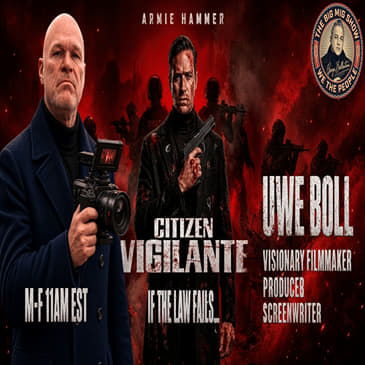
Uwe Boll is a a filmmaker who directed and produced 41 films, his most recent movie, CITIZEN VIGILANTE went to number one on amazon, apple, fandango and google play. https://bollfilms.com
HELP SUPPORT OUR SPONSORS,
If you or someone you love is facing cancer, Oasis of Hope offers FREE Zoom consultations for anyone who mentions The Big Mig Show. You have nothing to lose by exploring your options. Visit www.OasisofHope.com right now.”
[00:00:00] All men are created equal, but they are endowed by their creator with certain unalienable rights. By Liberty and the Beautiful. If Liberty means anything at all, it means the right to tell people what they do not want to hear.
[00:00:33] America Great Again! The Big Mig. Well, good morning. Welcome back to The Big Mig Show. Of course, I'm your host, Lance Miliaccio, with my co-host, my ride or die, George Valentin. And on this show, as you know, it's tip of the spear, edge of the knife. It's what we always do each and every episode because we're trying to educate and unify the country one episode at a time.
[00:01:00] So, of course, here we are doing what we do. George Valentin. Yes, sir. How are your brother? The weekend's here. What's your plans? What do you got going on, buddy? Oh my God, I'm working all weekend. I got suckered into working. I'll be working. I got construction work to do during the day and I got to work at night managing floors. So you're saying I shouldn't call you and bug you? You'll be on automatic block for the whole weekend. You know what's crazy? Everybody, he'll know that I'm working, but he'll still call.
[00:01:29] And just to talk about dumb shit, too. That's the crazy part. Listen, I miss you, bro. No, no. I can't help myself. I don't miss you, so leave me alone. That's okay. You don't have to miss me. It can be a one-sided, you know. Definitely is one-sided. I got to be honest with you. No homo. I mean, come on, buddy. Sometimes I miss you over the weekend. I just want to hear your voice, you know? It's definitely one-sided. I'm going to be honest with everybody. Boy, you know, that's a low blow even coming from George Valentin. I can't hear the drill, bro. What do you mean? You know the drill.
[00:01:58] If you love the show, thumbs up, comment, share, and subscribe. Hit that follow button. Do what you can to support the show. You can do a paid subscription. Fantastic. Rumble rant tips. Always appreciated. But those follows are the most important thing. The sharing of our content. Think the short form and the long form. George always does short form. Use it. We're not going to come after you. We want you to grow your own social media. You can grow it on anything that we're doing here. Take clips from our interviews and otherwise. It's what it's all about, helping each other.
[00:02:24] Because of course, listen, if you don't help expand our voice, who's going to? Because we're stuck. Without you, it's just George and I talking to each other and you heard him. He doesn't even want to hear me. So at the end of the day, and if you'd love to sponsor the show, info at the bigmig.com. That's right, info at the bigmig.com. Of course, we always appreciate everything that you guys do for us. And, you know, here's the thing. We love our sponsors because we love to provide products that, of course, you know, are great for the audience.
[00:02:52] Maybe provide something that you can't get elsewhere. And, of course, in the case of our most recent sponsor, there's something truly remarkable that's happening in the world. The cancer care just south of the U.S. border. And since 1963, Oasis of Hope Hospital in Tijuana has been quietly redefining what's possible for patients phasing cancer. And, of course, their integrative approach treating the body, mind, and spirit has produced survival outcomes that far exceed standard American hospital averages.
[00:03:22] We've talked about the medical industrial complex on this show many times. And the great thing about Oasis of Hope, they are beating U.S. hospital averages by more than three times in many cases. Just as an example, stage four cancers, the difference is striking. So listen to these numbers closely. Pancreatic cancer, 25% versus 2%. Melanoma, 75% versus 24%.
[00:03:48] Breast cancer for the ladies, 75% versus 24%. That is an incredible difference. And across prostate, 50% versus 28%. I think that pattern is very clear. The patients at Oasis of Hope are living longer with better results than ever expected. And at the center of this extraordinary story is Dr. Francisco Contreras. If you didn't catch his intro view last week, I would recommend you go back and watch it. Great guy, super knowledgeable. His family is a family of oncologists.
[00:04:18] And he's an author of 15 different books, which is incredible just in itself. Medical director, and he leads a compassionate team at Oasis of Hope dedicated to giving patients not just treatment but hope. So if you or someone you love is facing cancer, Oasis of Hope is offering for our listeners, the Big Ming Show listeners, free Zoom consultations, and a copy, a free copy of Dr. Contreras' most recent cancer book.
[00:04:46] So give him a call after the show. You head over to OasisofHope.com, grab that phone number. Don't delay. Share it with your loved ones. Because at the end of the day, Oasis of Hope is making a very big difference in the cancer community. Check it out. All right. I'm excited about today's interview. I love his movies. He's, you know, and he's joining us from Germany. We had a little screw up yesterday, probably my fault with communication, of course, different time zones.
[00:05:16] He's a great filmmaker, a visionary producer and screenwriter, you bull. Listen, if you love action films, and if you love films that have an underlying message, this is the guy's films that I would watch. His most recent film, Citizen Vigilante, is out now. You know, he's directed and produced 41 films. He's worked with Jason Statham, Ben Kingsley, Ray Liotta, J.K. Simmons, Christian Slater, and many more.
[00:05:46] You might know him from his movies, Rampage and Postal, which of course turned into cult classics. But his latest movie, Citizen Vigilante, went to number one on Amazon, Apple, Fandango, and Google Play. And I can tell you, I've seen the film and I understand why. The message in it is very clear. Again, like I said, he's from Germany. And you look at this, what he's done here. He started making short films as a teenager. He studied directing in Munich and Vienna.
[00:06:15] He earned a doctorate in literary studies from the University of, and I'm sure I'm going to butcher this, Sigen. I'm not sure I did that right. In 1994. And he started, you know, right in 91 with a film called German Fried Movie. And there's so many titles. Alone in the Dark, Blood Rain, and The Name of the King. And I've seen so many of them and watched so many of them and enjoyed them. So let's not, we're not going to waste any time. Let's get him in here. Hold on. Before we do, I just want to say, Jimmy Beyond Rumble gifted five subscriptions. Thank you, brother.
[00:06:45] And the Mike Schwartz show rated us. So go check him out. All right. Welcome to the Big Migs show, Uwe Ball. How you doing, Uwe? Hi. Good. Now is it pronounced Uwe or U? Uwe. Uwe. Uwe. Uwe, yeah. But I'm good with whatever. I'm going to turn an accent on. Yeah, yeah. I know. It's not so easy to say it. Yeah. You know, man, you've been in filmmaking for so long. You've probably seen every side of it.
[00:07:15] The dark side of Hollywood, the dark side of the critics. You know, the political manipulation, even distribution. I know how complicated it is. I know some people that invested in the film industry and they always talked about the marketing and the distribution fees and how excessive they are. You know, but you went into this genre that I didn't know. I didn't know was actually called this genre. Can you tell me about this video game movies, kind of what that means for the audience? Yeah.
[00:07:43] I mean, that's basically movies based on successful games. And I was kind of on the forefront with House of the Dead, Alone in the Dark, Far Cry, Blood Rain. And basically around 2003 to 2010. I did a lot of these movies. At that point, there was not like today's time. You have video game based movies left and right and down and up. You know, Prince of Persia, Warcraft. So many.
[00:08:11] The Last of Us are now like mainstream. At that time where I did them, there were still this kind of little brothers of comic books. And there were not like we had Street Fighter. We had Wing Commander, but we didn't have a lot of them. And then I came and I think I was the first one who bought this right strategically to felt like we do a row of that movies.
[00:08:41] And then we have at least the worldwide audience because that games were played everywhere from Argentina to Japan. So you're not stuck in one country. You can sell it to everybody. And that was a good time, basically. You know, I'm very happy about that. I did that movies. I didn't get really great, great reviews for it, but they made money. Yeah. Yeah. And of course, that's what it's all about.
[00:09:11] You have to have a return on what you do, especially when you put in that kind of a work. You know, let's talk about Hollywood for a minute here in the United States. There's been kind of a trend. We've had a lot of celebrities that just can't seem to keep their mouths shut and just stay in their lane. Most recently that the store of Reacher made a major mistake. And of course, his movies flopped at the box office. You know, is he going to recover? I don't know.
[00:09:37] When they come out politically and some of them have alienated a certain base, I always feel like as a an actor or somebody that's producing movies, you almost have to stay in the middle of the road. Not that you can't have a political message. But I think when you vocalize too far one direction or the other, there's consequences for that. What do you see in Germany and what do you see in your films? Do you feel like that holds true? Good. I mean, I don't really do German movies, you know, so I basically do American movies.
[00:10:07] I'm sitting here in Germany and then I go and shoot mostly in other countries, not really in Germany. I, in a way, gave up the German film culture a long time ago because it's completely corrupt and subsidized. You know, if you don't, if you file in Germany for a subsidy to make a movie, if you don't have like a migrant being the hero, a transgender being the assistant and like Asian black people all mixed up, you're dead.
[00:10:37] I mean, you're not getting subsidies, you're not getting a TV deal. So that's how diverse it is. And it's just like senseless. And in Germany, also Netflix, Amazon, they produce also German stuff, but they follow basically this route. And if you make more like harsh genre movies like me, they would never get the money for Rampage or Assault on Wall Street or Daffour movies I did in Germany.
[00:11:06] So I always had to look out for the whole world and try to get the money out of every country individual. And it was good that I did this. So I'm not totally depending on Germany. So if they fight me like with Statista Vigilante where they didn't give the film a rating at all, that's not the end for me. You know, it's like, OK, but then whatever. Germany will not make a lot of revenue. So but other countries then even more.
[00:11:37] Yeah. But I think in Hollywood, what I saw is what I see is this like Hollywood per se is 90 percent left wing vogue. And a lot of actors who maybe are more. Republican, right wing pro Trump, they cannot say this or act on it because then they're out of the business.
[00:12:04] You know, I don't I don't think you're out of the business when you see look at Mark Ruffalo. Right. Mark Ruffalo is hands down a good actor, you know, and so is Robert De Niro. Right. So but but the stuff they say, if you are doing hate speeches like them. Towards the left, you know what they do towards Trump and whatever, Israel, everybody.
[00:12:30] So then they are basically they're not they still getting hired. He will still get hired from Marvel playing Hulk again, whatever. He's not losing one job with his insane speeches he is doing. You know, but let's say you do a similar insane speech, trashing everything like whatever. Give a shit about gays, transgender.
[00:12:54] Let's say you really go for it and you insult minorities, you insult migrants, you insult left wings. You're done. The way we let the career is completely in the toilet, you know. So, I mean, it's it's not really when you said they have to be political neutral. Yeah, that's I think for actors the best step to do.
[00:13:15] But it's really like what really brings you out of business is if you're more conservative and more on the right side of the spectrum. You know, it's it's interesting that what you mentioned about Germany, because, of course, DEI has infiltrated everything here. They're trying to I feel like they're constantly trying to groom us, groom our children. The transgenderism and that ideology, the way they're force feeding us. You know, it's it's it's pretty incredible.
[00:13:45] And you have to realize when it comes to operations and it comes to narrative control, you know, there's lots of names for it. You know, they like to tag a name on it like Operation Mockingbird, but it's much more sophisticated that you look where you follow the money trail.
[00:14:00] You look at things like George Soros and Alexander Soros and the funding they got from USAID and what a lot of the U.S. money has gone to, you know, transgender operas in India, condoms in South America. It's incredible when you start looking through how the money was spent. And of course, we know it funnels back to our own government. You know, you you have a Ph.D., correct? In literary studies. Yeah.
[00:14:29] Like a lot of that early training still shows up in how you make movies. Yeah. When I research something, you know, like I mean, what the I cannot say that that whatever I remember every book I read and all this stuff. But I think what when you study literature for real in the university, you look different as like whatever you get a book and then you think, OK, what was this writer where he was born?
[00:14:57] What was his social environment where he wrote that book, you know, and you really look a little deeper into the surroundings of a writer, the surroundings of the world he was living in, the people who paid him to write a book. And you you go a little deeper as you just read a book and you think like that shitty book, good book, whatever.
[00:15:20] So, I mean, that you learned in the university at that time when I was in Cologne at university to study to study this. It it it opened a little more the research mind to not just take everything for granted. You also have to see, like, as I said, like what was also the social climate or the country where that book was written in? What was the the was that guy wealthy or poor?
[00:15:49] So all this stuff in the very end when you want to go deep and all that matters, you know, and that I, of course, when I look into political situations like whatever was it is vigilant of the migrant crimes in Europe. I do my homework. You know, so and that's to really see like to look through criminal statistics and really look into it.
[00:16:17] You know, when, for example, in Germany, they always say Germans do more crimes as the migrants. So there are two things to attack. Right. The one is, OK, but what crimes? I mean, it's a completely different crime to do tax fraud or to step somebody in a subway out of the blue. So that's that's already where you have to look into it. And then you have to see also a lot of Germans with a German passport, but they're not from Germany. You know, I just had the passport in the US.
[00:16:47] They tried that also. Right. To give a lot of people the American passport is so that they basically also take them out of the statistics. Then it's like, look, the Americans doing one crime after the other. Yeah. But what Americans who is who is actually doing a violent crime, random stabbings, rapes, whatever. So what is it? So and that's that's the thing where. In regards of the migrant crimes were used in my movie, I can defend this.
[00:17:16] I mean, you can imagine I got so attacked from my movie because nobody would make a movie like this to show actually mass rapes, gang rapes and stuff like this. And to say, look, guys, you all do nothing else as to sugarcoat crimes from Islamistic migrants who came into Europe the whole day.
[00:17:38] You try to cover it up. And that's also a thing like I mean, you mentioned George Soros and I had a discussion with a friend like a few days ago. What I don't get, I just don't get it. And I ask you, maybe you look deeper into it as me. But what drives George Soros? To do what he's doing, what is it? I mean, he's a billionaire. Right. So so what what happened to him or why he's doing it? Why?
[00:18:06] I mean, he's very old. I don't think he's doing it for the money. So he's doing it. I think he's doing it for a few reasons. One is control, but he could be working for a bigger faction. And trying to get them more power and control. And they work through him. You know, there's old sayings you think about, like they talk about the Illuminati and other factions, you know, you have to maybe think about that. I mean, Soros is one of the devil's minions.
[00:18:34] Him and his son, they deserve to be taken out and removed. Yeah, but look, they are Jewish, right? They are Jewish. So why are they supporting so much like terror and Hamas and whatever, all this stuff, free Palestine? Why? I mean, they would be the devil does not care about Jewish Christian this and that. You know, I have my take on it. I think that the Soros is and I think George is right. I think there's somewhat of an operation.
[00:19:04] I don't like to get too conspiratorial because, of course, many people poo poo it. But there's lots of things I saw when I was a government contractor. And I really believe that there had to be something else going on because what the operation was supposed to be and what it finally became were two different things. In the case of Soros, I think it's power and ultimate power corrupts. Now, is George correct? Is the power linked to a larger operation or narrative behind the scenes? Maybe because you're right.
[00:19:33] It's confusing when you see somebody Jewish. And yet here he is funding operations. He uses open society. 64 separate NGOs, money funneled through them in all sorts of directions. Here in the United States, he funds leftist operations and, you know, secretaries of state. Even in my own state, I'm here in Denver, Colorado, currently. Jenna Griswold and others have received funding from Soros. They support his agenda. You look at the connections to Hillary Clinton, even Huma Abedin marrying Alexander Soros.
[00:20:02] It seems like the incestuous nature of government. And as a person that's seen government operating behind the scenes and been involved in, you know, black operations with multi-agency teams from different governments. I think there is a bigger plot here. And I think when it comes to division and chaos, that's one of the goals of George Soros. Because let's face it, if the United States with their 300 plus million, you know, whether it's legal or illegal, we don't really know.
[00:20:33] You know, Greg Bovino came out and said there's over 100 million illegals in the country. Our own government claims 30 or 40 million were here. You know, that border invasion was done intentionally to control our government, to manipulate the elections because they were trying to create this massive ghost voter pool. These people, nobody really knows where they're at. They moved all over the country once they invaded the border. And they came through both the south and the north border. We often talk about the south, the southern border. But I think Soros' ultimate power corrupts.
[00:21:02] I think he likes the power and manipulation. I think he's hooked on it. I agree with you. You would think the guy would just go into retirement, enjoy his life, spend his billions, spend time with his family, hopefully have some grandkids through his son. But it doesn't seem like that. It seems like he would rather, you know, cause, you know, destruction. He would rather, you know, maybe smile from the dark curtain and hope that what he's doing is effectively destroying the U.S.
[00:21:30] I mean, look at Russia's position on George Soros. He's not allowed in the country, but yet Soros has a mansion here in upstate New York. And I've said it many times. I have a dark side that I struggle with. You know, maybe because of my background, you know, my idea to clear up government is an industrial wood shipper. Is that the right idea? Probably not. You know, I don't think I'm popular because of it with our own government. You know, George and I took the suspensions for our voice.
[00:22:00] You know, just like I looked through your history and the attacks on you have been incredible. And I think a lot of it comes, you know, that you aren't really willing to compromise. You know, you there's a lot of things that you have stood up for. You've smuggled politics into genre movies. And, you know, and some people have called it a lecture. And to me, I think it's intriguing.
[00:22:24] I almost call it fiction reality is a term I coined where you take the truth of what's going on like the illegal immigration issues. Tommy Robinson is a close friend of George and I. We've known Tommy for a long time. He's been fighting so vocally and you see that what they've done to him. Do you feel like the system takes a look at, you know, you and they decide that, well, shoot, we've got to stop him. He's putting too much truth into his movies. Is that something that you struggle?
[00:22:53] Because, of course, sometimes your movies even hinge on a little bit of a lecture, but I feel like it's not a lecture. It's more about educating the masses to what's really going on. Do you feel like those attacks come at you very directed? Yeah, because especially if you go against the stream, the government, the powerful, you know, where you like look when you see Rampage.
[00:23:18] I did three Rampage movies and in the one where he kidnaps the TV station and then he says live on TV Obama killed way more people in like secret ops as everybody else before with drones and everything. But he appears to everybody like, whatever the world is great and I'm the best. So, you know, only because he made good jokes and it's rhetorically good. He did a very lot of bad things.
[00:23:45] And I predicted kind of a civil war like the thing about my Rampage three was before Trump turned president the first time. And I predicted kind of a storm of a capital will come, Washington, D.C. is out of control. There will be like kind of a civil war breaking out. There was before Trump came in and got elected. So and I think that's also like what I mentioned in the beginning.
[00:24:14] So I look a little longer or deeper into subject matters and then I come to a conclusion, you know, because I felt, for example, if you would ask me 10 years ago, I would not see an existential threat in Europe through that migration. But then it went completely out of control and it was 10 years mayhem with more as 30 million Muslims into Europe. And it doesn't stop.
[00:24:42] England is completely off the charts already. And now, since two or three years, I see that as an existential threat because they don't come with intentions to adjust to the culture, to the politics, to the freedom, whatever. They're coming and they bring their religion above the law and they're not adjusting.
[00:25:09] They don't learn from, OK, I was in a really bad shithole country. Now I come to Europe or the Somalis coming to the U.S. and all that stuff that they say, OK, why I want to left my I left my country because it was horrific for whatever reasons. But I wanted to really leave. So now I enjoy the new country, including the culture, the rules. I put the book off. You know, I stopped doing all this shit. And but they're not.
[00:25:37] They think they are above everybody. They feel they're looking down to the people. And you see that with the Hassan Piker's, the Syed guy, the Mandami and so on. You see it that there are like they're really first and foremost Muslims. And not like Americans or whatever. So and with this, I always have huge problems.
[00:26:05] You know, I think religion is a private thing if you believe or not, if you go to church or not. It's your private thing, but it cannot infiltrate the world we're living in or has political power. So, you know, it's like it has a lot of good morals, whatever. But my wife is Catholic and I'm an atheist. I never believed in God, whatever. You know, I just cannot. You cannot make it up. You believe or not. Right.
[00:26:34] So and I am not. So, you know, that doesn't mean that I think Jesus was the worst of the Ten Commandments. A lot of things in the Bible are very good. But if you put them in a lie detector and you would say, do you really believe there is something? You know, whatever miracles and Jesus gave you whatever wine and it was blood and all that stuff. I would say, no, I totally don't believe it. And I would pass the test because I actually don't believe it.
[00:27:03] I think when you're dead, you're dead. So you have to during your lifetime do everything good and right and look in the mirror and say, look, it's not like I hope for a better life when I'm dead. Like all that Islamistic idiots. So, you know, no, it's like now it counts when you live. That's my personal opinion. And as you said, it's just so in my nature. I'm not.
[00:27:30] When I believe something, I'm not like you cannot buy me. You know, to to just. I do something what elevates my career or brings my career up and I do things because I get money to shoot a movie where how great everything is, whatever. I could not do it. So I cannot really sell out.
[00:27:53] And I feel better like this, even if it's like getting attacked all the time and being not the the last person here in Germany, for example. You know, I got some quotes of you that you've said over the years and it proves that you you're one of those guys who put your money where your mouth is. You said, as a filmmaker, I feel that my movies have always done this. If you look at Rampage, they are often against the right, against the rich, against the powerful.
[00:28:21] And you said that you're proud of that sharp political edge. Do you feel like statements like that weaponized? I don't care whether it's Hollywood, the critics or otherwise, that maybe there was operations that were trying to, you know, attack you personally. And then, of course, attack your movies to try to limit their success. Yes. I mean, think about it. Rotten Tomatoes is owned, I think, by Amazon now IMDb.
[00:28:49] You know, like that film studios, they own this reviewers and they do a lot of advertising in the variety and all that stuff. So, of course, they are not having a lot of sympathy for like an individual what the studios don't want. So they're also on IMDb, whatever they're rating my movies down, like the algorithm, stuff like this. But also, I never had a Hollywood agent manager. I cannot stand Hollywood.
[00:29:19] So, you know, I think the longest I was in Hollywood was three weeks. I just cannot stand all these people. And it's, you know, I want to develop my things. I like to be like alone with my dogs and my family going here in the forest and thinking about stuff, writing stuff and making movies I really like. But I'm not like in the film club business, whatever, you know, all my friends have nothing to do with film industry.
[00:29:46] So, and, but it's better for me, for my health, for my bio-rism, whatever. But the fact that I never had a real Hollywood representation was, of course, not good for my career. You know, because it's always better you're represented by a big agency and, you know, and, but I just couldn't do it. I just couldn't do it.
[00:30:13] I met some agents, whatever, and they were all so phonies. Like I felt like, no, I can't. I just cannot have this you every day a call or contact. I don't want to have people like this in my life. You know, I spent a little bit of time. I did some acting over the years. I was in some series and some other stuff early on when I was younger. And Hollywood kind of made me nauseous.
[00:30:37] I would sit on the sidelines a lot of time and look at all the ass kissing on set and the behavior of this person gets to eat before this person. And this person gets a changing room and this person doesn't that class on sets of how they keep people separate. And of course, you know, treat people in a different manner. I never liked it. You know, I'd always kind of sit up to the side until it was time for me to do my part and then just come in and do my part. And that would be the wrap. I wasn't really willing to sit there. And probably because of that, who knows?
[00:31:07] Maybe I didn't have as much access. Maybe, maybe it's not as much opportunity. My agent was actually here in Colorado of all places. I had met her. A friend of mine wanted to try out for Die Hard 2 and I drove him down because he needed a ride. I ended up with a part in Die Hard 2, but it ended up getting cut on the cutting room floor. My best work on the cutting room floor. You know how that goes. So anyway, but you know, that's, that's kind of how it started for me. It wasn't really intentional. It was more by mistake.
[00:31:36] I was a pretty big guy back then. I'm still a pretty big guy. I'm like 6'1", 226 right now. And back then I was probably 245. I'd always been hitting the weight pile and kept in pretty good shape. But you know, you said something that I think George is going to ring out with you because you've said something similar to this. You said if you have a sense of humor, you love Postal, but it's offensive. It's kind of movie where I say I don't accept self-censorship.
[00:32:01] I don't accept the idea that you cannot do something because it's against a race, religion, country or whatever. George on this show, you said a whole lot of times screw that I'm not going to get censored if they suspend me. If they throw me off, I'm not willing to compromise my morality because somebody doesn't like what I have to say. Nope. What do you have to say about that, George? I saw the censorship line. I thought, man, that's George right there. The truth hurts. If you can't handle the truth, get the F out. I mean, it's too bad. We've been censored enough.
[00:32:30] But there's a question. I got David Aldridge. He's on YouTube. Ask a question. Ask what will be in CV2, citizen vigilante. I cannot tell you a lot, but we move into America and we shoot in America and it will be facing the problems in the USA. So, you know, and I think there are more as one problem.
[00:32:58] So we also will have a little more. Yeah. And like parallel stories. You can make so many sequels just deal with the USA. Yeah. You could have one citizen vigilante one through ten. You're going to need to get citizen vigilante a sidekick if you're going to start taking on USA. I'd like to make a suggestion for citizen vigilante too. And I want to talk about one. I want to go back to one here. I don't want to skip around two. But can we take out Hillary Clinton? Take her out of the movie.
[00:33:27] I'd like to make that suggestion that that's the culmination, maybe something towards the end where Hillary Clinton gets taken out because I think the United States would celebrate. And, you know, that's what why I think citizen vigilante is doing so well. You I think you've hit on something. I'm sure you knew it. I'm sure it's no surprise to you. We're fed up here. You know, George and I are in lots of chat rooms. We know a lot of top hosts around the nation. A lot of the big names.
[00:33:55] There's some private rooms where the top hosts have discussions. Most recently, one of the biggest screw ups by Donald Trump was talking about how he's not going to go after the deep state. We've also heard Todd Blanch, you know, because he made a statement just recently. It was just a day or so ago about how he's, you know, could have gone after Hillary Clinton. He could have gone after Barack Obama. He could have gone after Joe Biden, but he chose not to, which I think is a mistake.
[00:34:20] I think when people are that vitriol towards you, when they're that angry, when they have that ill intent, I don't think you have a choice. I think you have to take the gloves off. Let's talk about citizen. Wait, wait. Hold on. You said take the gloves off because somebody put this in the chat and I did not know this. Oh, you were a semi pro boxer one time. Yeah, I boxed 14 years. Wow. Yeah. In Germany, in a very good club by a Leverkusen.
[00:34:47] We there were a few times German amateur champions, you know, and so that was the best school for a young boy. And, you know, till like this kind of being aware of danger or countering and keeping keeping your cool. Let's say it this way. Right. So that you're not like getting the adrenaline rush anymore. If somebody attacks you and stuff like this.
[00:35:15] I mean, you had it yourself 100 percent all, especially if you are real like a contract in the war zone or whatever. You know that that's, of course, a totally different level. But I think in general, fighting sports are very good for your discipline. You're all alone. You're not in a team. You cannot blame other people. It's all you, you know. So if you fuck up, it's your turn. It's like you didn't train that enough or you completely lost your cool and stuff.
[00:35:45] So I love boxing. I follow this up like last 30, 40 years. I know all the fighters, all the fights. And yeah. You saw a lot of boxing in the United States to Vegas. Yeah. Yeah, absolutely. My uncle used to be the boxing commissioner in Las Vegas. He passed away from cancer probably like eight years ago. Well, yeah. Yeah. I know. I mean, that's for me boxing is still quite a bit. Yeah. Look, that's the thing. Right. I have a photo with Tyson. I met him in.
[00:36:15] It was funny in Kazakhstan in Russia. I made a movie about Mark Schmeling fighting against Joe Lewis. And that movie was running there. And Tyson was there with his documentary about himself. And so I saw him at the table as I walked straight to him. And I said, look, you're like, you were the most dangerous man ever in the ring. What I think Tyson on the peak was the best ever.
[00:36:43] Like nobody would be like, like there was like this three, four years of his life. He would pulverize everybody. But then, of course, everything went sideways. And so we talked for two days about boxing. He watched much mailing. He watched. I watched his docker with him and we chatted. And Mike Tyson is a great guy. I mean, he knows everything about boxing. Right. Everything. So, yeah. But of course, Terence Crawford. I mean, I follow really all the fighters.
[00:37:13] And that's a totally different podcast we can do. Only. Yeah, we can do that. We're going to take a break, Lance. All right. We're going to take a break when we come back. I want to touch on that again. Listen, it's the big, big show. You guys know what to do. Smash that follow button. Take the live link. Share it. Tell everybody that we're here having a great interview and a great time. Stay tuned. We'll be right back with you, of course, George Ballantine and Lance Miliacho. It's always edge of the knife on this show. We'll be right back.
[00:37:51] Something truly remarkable is happening in the world of cancer care, just south of the U.S. border. Since 1963, Oasis of Hope Hospital in Tijuana has been quietly redefining what is possible for patients facing late stage cancer. Their integrative approach, treating the body, mind and spirit, has produced survival outcomes that far exceeds standard American hospital averages. In some cases, more than three times higher. The pattern is clear.
[00:38:20] Patients at Oasis of Hope often live longer than expected. At the center of this extraordinary story is Dr. Francisco Contreras, world-renowned oncologist, author of 15 books, and medical director leading a compassionate team dedicated to giving patients not just treatment, but hope. If you or someone you love is facing cancer, Oasis of Hope offers free Zoom consultations for anyone who mentions the Big MIG show. You have nothing to lose by exploring your options.
[00:38:50] Visit www.oasisophope.com right now. Forged through rigorous training and honed by the finest instructors on earth, these canine units serve beside our nation's warriors as they fight to preserve what we cherish. When these warriors complete their duty, the Warrior Dog Foundation provides them with a home deserving of the service they've given us all.
[00:39:20] At our state-of-the-art kennels, they receive rehabilitation and care suitable for heroes, because that's what they are. Be a part of giving them a future today. Visit www.warriordogfoundation.org. This is the STAB Sawman Tactical Advantage Blade, built by former Marine and Navy SEAL Craig Sawman Sawyer.
[00:39:48] In the teams, every ounce had to earn its place. No extras, no excuses. That is why he built the STAB. 17 practical tools, no moving parts to fail. CPM D2 tool steel, hardened to 60 rockwell. Tungsten carbide glass punch on the pommel. It clips on a belt. It mounts on a plate carrier. Reverse grip or conventional. It stays pro. Built for the work.
[00:40:15] Rain, night, salt, mud. Created for adverse conditions. The one he carries now. Grab yours at sawmantacticalblades.com. All right, welcome back to the Big Big Show. Here we host Lance Migliaccio, George Valentin, and our very special guest coming all the way from Germany.
[00:40:41] Sprechende Deutsch. Uwe bald. Don't forget to hit the thumbs up button, the like, follow, share, and subscribe for $5 a month. We truly appreciate it. Every little bit helps. Most importantly, your support. Matter of fact, I just found you on X. Just followed you, so if you see me. Oh, okay, good. After the show, I will check it out. So we're talking about boxing before we get into citizen vigilante. Do we want to continue boxing or?
[00:41:07] Yeah, I just want to bring this up. I feel like what you said on the break about Mike Tyson being able to sense what was going to happen. He was a smaller guy, and he needed to be on the inside. I feel like that happens with people that have the experience that you have, that have the experience of Mike Tyson. And martial artists in general talk about this slow motion effect that you, that as you become more conditioned and as you do this, you know, and they say to become an expert in anything, you need 10,000 hours.
[00:41:33] I don't know how much I have in combat sports or hand-to-hand combat or knife fighting or some of my other skills. Um, but I probably have every bit of 10,000 hours at this point because I'm 63. So of course you get older, you get more experienced, you understand things. Do you feel like a lot of that discipline and the patience that you learned while you were boxing, while you were training, is that, do you feel like that's been super helpful in your films?
[00:41:59] Because I would imagine it is. I would imagine the conditioning you went through and that ability to see things from that perspective. I, I, doesn't that convert to the lens when you're shooting these movies? Yes. And it helps you also to go through like stressful things. You know, we had like on blood rain to house exploded and everybody had to get evacuated and the fire trucks came.
[00:42:24] We had on in the name of the king also catastrophic, the heater exploded in the tent. People were burning. We had to tackle them down to get the flames off. And, uh, so, you know, I shot in South in tunnel rats, the Vietnam war movie. We shot in like Durban and it was like black mamba Valley basically where we shot.
[00:42:45] So there was various, like you sit there and the snake comes by and, you know, and the best is of course, to not do anything, to just, just sit there and don't move. And then the snake would just keep crawling away in the bushes. But, but for me that experiences in a way, I think helped also in other situations. Sorry, my fault. Oops.
[00:43:09] You know, happened in where you are staying firm or also not intimidated. You know, when we shot blood rain one in Romania, we had really like a gypsy gang. They wanted to blackmail us, you know, and, and then it's, it's, it's important to not like bend over and to, to really make sure like, no, you're not getting here because we're shooting here. We paid the location.
[00:43:36] You're not getting extra money and you can fuck off, you know? So stuff like this, where I think that totally helped. And interesting is, and I mean, you know, a hundred percent too, you have so much fluctuation in fighting sports. So many people want to learn to beat people up. They're coming in and then they get beaten up, right? And they stop doing it. And, and I think what you really learn is you learn to take shots.
[00:44:06] You learn to get pummeled. You learn to, you know, I never got knocked out. I was only a few times dizzy in sparring fights, but my fights are basically one all. I did only nine fights and I won them all, but I did like thousands of sparrings. And the, you learn also how to get out of a situation when you feel, for example, I did sparrings with Darius Misziszewski, the tiger.
[00:44:31] He was 49 and 0, almost like, like Calzaghi and the half heavyweight professional world champion later. And, uh, if you do sparring and these people, Olympic athletes, uh, you need to survive. You will not beat them. And you just have to try to survive three rounds each three minutes in the sparring.
[00:44:53] Uh, but that's teaching you lessons, you know, to go through pain and to, to not give up and to not like run away or whatever. And to also take it that, that today it really hurts. I cannot chew for two days, but, uh, I survived in the ring. Uh, that for me, that was very, very, I did that for 14 years. Um, and that was for me very, very important for my business later, you know?
[00:45:23] Yeah. You just define the warrior spirit, you know, when you, when we, we have a lot of interviews with special operators, Delta Force, Marsox and SEALs on this show. Much like Sean Ryan. I know a lot of them. I'm friends with a lot of them. Uh, you know, I was just talking to a couple of them last night that are ex Delta Force. So you're talking about tier one operators, but that, that warrior spirit, you know, everybody's a tough guy until they really get hit. And you're right. Many people want to go into these schools or they want to spar, they want to do whatever. And they've never really been hit before.
[00:45:53] They might've been a bar tough guy, you know, where they, where the, where they, uh, take a fight with somebody that's drunk. They come out victorious because you know, he, who first strikes first usually, uh, but they've never really been hit. And then they get really hit and you see the reaction on their face. And of course, sometimes they never come back and that resilience that you just described, it's obvious in your movies. I feel like that really comes through that you, you're a resilient guy and your timing has been very good.
[00:46:22] Sometimes the topics you picked are right over the target, which you have to be well-read. I think that's where your literary PhD comes in. Let's talk about citizen vigilante one. Let's focus on that for some time here, the, what we have left for the interview. Your timing on that couldn't have been more perfect. George and I, uh, don't like, there's a lot of things Donald Trump and this administration doing correctly. We think he's still got some nefarious operators around him.
[00:46:51] People that don't necessarily have, uh, the right agenda or the right intent. He did it in the first term. I believe we have it still in this second term. There are some that I love. Tom Homan, uh, Pete Hegseth, uh, JD Vance. I think Marco Rubio, I believe these are people that are really trying to do the job and they're doing it well. I like Kristi Noem. I know what happened behind the scenes and why she's gone now, but I think that she really was trying to do the job the right way.
[00:47:18] Uh, but citizen vigilante, man, your timing was just spot on. I believe that's why it's doing so well. I don't care what Hollywood or critics have to say. I care about what people say and they love the film. And I, and I think you've really hit, uh, a resonating, uh, moment. Cause I, as I mentioned, I started to mention earlier, the chat rooms on the major shows and all the other that George and I are in, we, we hear lots of people behind the scenes.
[00:47:44] They're unhappy with the invasion here and you know, uh, elsewhere in the world. Uh, they're unhappy with world government is what started you, what, what made you pick citizen vigilante as your next film? Kind of what triggered that? Was there a moment in Germany or was there a moment globally, or you were looking at us news and said, you know, it's time to really show what maybe is going to have to happen to fix this.
[00:48:06] I mean, it were like, of course the, in general, the statistics in general, you could see, like, for example, I live here by Frankfurt, the Frankfurt railway station area. You can't, you basically cannot go there anymore. It's like only druggies and foreigners and it's horrible. And so you feel also in inner cities, more and more, more very religious Islamistic people, full bore cars.
[00:48:31] It really growed in the last few years to an excessive disaster, but two cases like one video I watched was where a guy in Paris or whatever went with a baby stroller. Uh, down and a guy stabbed him from behind in the neck and he bleeds out in front of his baby on the ground. He's dead. And the baby stroller is there and some amateur film that was the cell phone.
[00:48:58] And then the case I used in my film, the Hamburg, uh, Stadtpark case is the mass rape, the gang rape, where a 15 years old girl in Hamburg got raped first by four migrants. She was on a fair, got dragged in the bush. So four migrants raped her. Then they took the phone away and her wallet. Then she run around on the fair, tried that people help her. Nobody gave a shit.
[00:49:27] So the four migrants grabbed her again, got four more bodies, went back to the bush and raped her additional. So eight DNAs were in her. And this guys never went to jail. And the judge said there are victims too. There were traumatized Afghanistan guys, whatever. And it doesn't bring her anything that the rapists go to jail.
[00:49:56] And the media in Germany defended that judgment. So now the same rapists are on the street where the victim lives. You know, and I felt like if I would be the father of that girl. I would try to kill them. You know, like personally, like I would not let that slide.
[00:50:21] So and then then I felt I should do a completely unapologetic movie. What is totally not even like, you know, like the pro and cons. No, I skipped that part. And it's really that was also important that that my vigilante comes to the intellectual conclusion that the law doesn't work and he has to fix it.
[00:50:49] I that's the reason I because people told me like also because I didn't get a rating in Germany for it. They said, look, if the father like this wish was Charles Bronson would do the revenge, that would be different. But it's an external ex-military guy who just feels I should do it. And he's doing it. That made the movie so dangerous, as I said, because a lot of people who have maybe military background would be inspired by it.
[00:51:18] You know, and I said, look, you know how how they will be not inspired by it in changing this in prosecuting rapists in not letting people into the country. Throwing people out on the first crime and not like understanding and getting social welfare, free housing, whatever. And then they do a crime and then like, OK, but look, he comes from Somalia. We cannot really punish him.
[00:51:48] He doesn't know it better. No, I give a shit. You know, like I'm in Germany. I'm not in Somalia. So and that's that's the thing we why we why we spend all that money on them and go in a security risk because random crimes is a totally different thing.
[00:52:06] You cannot prepare yourself for walking to a store and the guy comes from behind and stabs you in the neck like the guy with the baby saying nobody can protect yourself from it. You know, and especially also not girls who get grabbed, who get raped and so on. We had over 30,000 gang rapes in Europe within two years, over 30,000. We're not talking about like 20. So it's like a knife stabbings alone in Germany, 40 to 50,000 a year.
[00:52:35] Not everybody will be dead, but that people running with an axe in the supermarket around and flipping out and threatening people with an axe or something. I mean, sorry, but we don't need that. You know, I mean, I think it's ridiculous that we brought our population in this kind of risk. You know, and you're right about that. A random act of violence you can't really protect yourself from.
[00:53:05] We've all been, you know, in places as you've traveled. I'm sure you've seen that you have to have situational awareness. But when something is just random out of left field, you know, George, we've talked about this a lot. You know, one of the films that really took off here in the United States was Law Abiding Citizen. And, you know, that quote about I'm going to bring the whole fucking diseased, corrupt temple down on your heads. It's going to be biblical. Maybe one of the strongest lines in there because that's what the people in the United States feel like.
[00:53:34] And I think that's why citizen vigilante. George, we've you've said that you often say, can we fix government? And go ahead and take it from there, George, because I don't want to put words. Can we we can't fix our government? Our government is far too gone between everybody in Congress to the three letter agencies. FBI, CIA, NSA. There's so much corruption. Nothing has been corrected. And if nothing gets corrected in this administration, nothing ever will. This was our time, our shot. We thought we got the right people in. I'm still hoping for it.
[00:54:04] We'll see. But at this point, it's we need to. I say we need to start over. And can we do it peacefully in the courts? Maybe. Maybe. But I think it will be tough because our judicial system is just as screwed up. So, I mean, as citizens, we have to just figure out how to unite and conquer. And there's ways to do it. You just have to do it like your military style. You have to have one per one head of person from every state have people under them.
[00:54:33] And you just control it that way. And then we just come together. I can't give more details, but that's about it. George, if you're ready, I'd like to play the clip because some people in the audience might not be familiar with citizen vigilante. And I'm going to recommend you go watch this film, number one, for everybody out there. Let's play the trailer that we've got. Here we go. The truth is this. You are all being used.
[00:55:00] The vigilante citizen is delivering a brand of justice that some believe the authorities have failed to provide, targeting both criminals and those in power accused of allowing crime to flourish unchecked. There's been a lot said about me, so I thought you should hear directly from me. I'm here to help you take that control back. The state, court, police.
[00:55:28] See, you think that they've failed you, but they haven't. Now they only exist to control you. Do you want justice? Yes. Let's get some fresh blood. You walk down the street and you get stabbed or robbed. He's a real hero. We need more guys like this. What does your country do? Nothing.
[00:55:57] Our current system is failing to protect our citizens. He's like, the real deal. He's playing with us. What if everything they ever taught you was utter nonsense? We can change history.
[00:56:23] I have to say, I love the message. I'm laughing because at the end of the day that maybe that's my dark side. You know, not that it's supposed to be funny, but I find myself thinking we need more of this and we need it right now. You know, and it's interesting how your own government reacted by not giving you an age rating.
[00:56:50] Talk about, you know, left sided censorship. Any other countries reacting the same way to this film that they don't want distribution and they're trying to block their own populace from seeing it? Because I think the movie has a compelling message and I think it's resonating with so many people. I know it resonated with me. You know, I often think, you know, is it going to take this what it's going to take to clean up the situation we're in? Because I was hopeful.
[00:57:20] We're friends with Cash Patel. He's been on this show. When I heard Cash was appointed at the FBI, I thought they might clean up that agency. What other countries have reacted like Germany, maybe in their own kind of an operation to slow down the exposure for this film? No, mostly then negative critics or whatever and bashing it like Piers Morgan. But only Germany has that special thing. Like in other countries, the R rating or NC-17, that's the maximum you can get. But they give you a rating.
[00:57:50] Germany is the only country where they refuse to give it a rating because then they know you cannot show it. Like the streamers don't put the movie up, right? So and that's only in Germany where that rule even exists to say we don't give you a rating. And even if you paid for it, that you get a rating. I think it's a political thing. I also at the rating screening, I was at the screening number three, what was insane.
[00:58:17] And I said, look, guys, if I would have five neo-Nazis raping a 15 years old Syrian girl in that movie, I would get an R rating. A hundred percent. But that he kills migrants because they do the gang rapes. That's a fact. They do the gang rapes. So I make a movie about a real situation. What actually happened in Hamburg?
[00:58:43] And you don't want to give it a rating based on a movie based on a factual case where everything went wrong also in the justice system. Right. So and now, yeah, that was the point they in every elections. Now, Berlin elected a left wing like whatever from the river to the sea coalition. Last weekend was the election weekend and the left wing party. They're really communists.
[00:59:11] They're the ex-communistic party from Germany where the DDR was still like the Russians. So they won the whole election. And that's like New York. Look at. So that's when George said it needs like more people revolting. But the reality is, look who's the elect. So I think the brainwashing worked.
[00:59:34] And I think that the media 80 percent, 90 percent is left that shows it now in that elections. It shows that what's going on in the universities and so on. It's it's almost a lost cause, to be honest. Right. So it's like very, very bad. And I think it needs it needs too long to turn this around because you would also have to go back to schools and say, look, what you got teach whatever the last 10 years is total bullshit.
[01:00:04] And we need to stop the infiltration. And this this love for like left wing extremistic Islamistic bullshit. It's like there's nothing good in Islamist in the Islam. Like, you know, like you can be a Muslim. It's your turn. But there is nothing good in it. It's like it's all like bullshit.
[01:00:30] And it's it's like it ends up in the culture is gone. Technology is gone. Natural science is gone. Free media is gone. All gays are dead. Transgenders are dead. Women's have no rights. That's what the end result is. If you just keep going, that's you know, you say women have no rights. But yet these dumbass white liberal women in this country stand for this Islam and all this shit. It's beyond. Yeah. Yeah. Recognizing what Sharia law is all about.
[01:00:59] You know, I've seen it up close. I don't like their I'm a dog guy and I'm an animal guy. I don't like the way they treat dogs, children or women. Many times I looked down a scope and saw things going on. Sometimes I was able to interact and change the event. Sometimes I wasn't able to. And it's frustrating when people talk about, oh, you know, let them do their thing. You know, let's this this Islamic evasion here in the US, the people that are supporting it have no idea.
[01:01:26] I think I want to send them all to the Middle East and you spend some time in some of these nations and just be put on the ground without any support and figure out exactly what's going on. And I think they would have a difference of opinion, especially some of these women not realizing what would happen to them there without a man with them. Because, of course, that's an opportunity for rape. You know, some a lot of people are talking and calling this film a death wish for this decade. I grew up with Charles Bronson.
[01:01:53] I never felt like he was a great actor, but he was wildly popular for his death wish series. And again, I think it resonated with people. Your casting has always been spot on. I always feel like casting. The reason that I will badly critique a movie is I hate when they pick the wrong guy for the wrong job. You haven't done that. And on top of that, your your action play, your gunplay, your physical action between individuals, probably because your boxing background is always really accurate.
[01:02:23] I can't stand the unlimited gun magazine. You know, there's nothing worse than then. And I guess as a guy that spent a lot of time working on my my skills and my tactics. I want to see accuracy in a film. I want to see what really happens in these situations where things don't always go perfectly. And you bring that forward. Do you like the comparison to death wish or is that you feel comfort with it? And a hammer, you know, what a great choice. I mean, I love him as an actor.
[01:02:51] I know that he hasn't always been as popular as I believe he should be. Let's talk about that for a minute. No, I mean, I love Charles Bronson, especially for once upon a time in the West from Sergio Leone. Right. So it was Henry Henry with Henry Fonda, one of my favorite movies. But that's which also. But you're right. He was not the greatest actor, but he was perfect for this ice cold revenge guy. And I mean, look at New York at that point when they shot the movie. There was that problem.
[01:03:20] Like you had rapes. You had like you could not go at night as a woman out in the subway was very unsafe. And I think good movies should always reflect or have something to do with reality. And in regards of the fighting, I 100% agree with you. You know, whenever movie like John Wick, the John Wick one. I loved it. And then now I cannot watch it anymore because now I mean, he's not Superman.
[01:03:49] He's like a normal guy, basically, who can fight, you know, and now people shooting with mashing guns at him from three meters. And he has nothing. He lifts up his jacket and block. I mean, completely absurd. And that's where I step out of. I hate this superhero bullshit. If you make a movie like Equalizer was Denzel Washington is a little more realistic and better. Right.
[01:04:13] So if people turning into superheroes who are basically normal people, then I they lose me out of that franchises, you know, Fast and the Furious. I love the first two. And then I could never watch it again. It's horrible. It's total bullshit. Everything is so over the top that I'm, you know, the first James Bond's like James Bond was realistic fighting, doing stuff. You could feel like the guy could actually do it. And then they started with all this CGI.
[01:04:43] You know, you jump from train to train and then you climb on a helicopter. I mean, sorry, but that doesn't happen. You're dead. You know, you can also not jump from the third floor on the hood. Yeah. And I mean, you're you're you're you will not go from there anywhere. You go to the hospital and maybe survive. So that's I'm a big fan of this kind of stuff. I love Ronin, for example.
[01:05:08] You know, they did a real car chase in a tunnel against, you know, like stuff like movies. I grew up with French Connection, you know, the old Scorsese stuff. All of this was doable. And so I like real realistic approaches and, you know, and not this total over the top what you have now in a lot of action films.
[01:05:37] So, yeah, Ronin was interesting. They've even used some of the reloading to train military here. Some of the reloading on there was extremely accurate in the gunfights. People don't know that. But the gunplay in that movie was extremely accurate. And that it's just interesting. And I think that I think that's one of the other reasons people love your films. I think accuracy and you're right. John Wick, a lot of people didn't know center access access relock.
[01:06:06] And if you understand that the technique used in that film, that's what it is. It's much like people that combine martial arts, MMA, UFC. I had become too old. It was already when it first started. I was actually with the Gracie's at UFC one and two. They had that in Denver, but I've gotten to know them otherwise. And I was hanging out with them. But when you and that's what's happening in the world of mixed martial arts, the combined art. Right. I did that years ago where I took lots of different arts because I think there was lots of things.
[01:06:35] You know, if you were doing Muay Thai, the leg kicks, the knee kicks, the elbows, the striking. There's no doubt that for hands skills, boxing is still the king when it comes to that. But there's lots of other techniques from different martial arts that you can use and you decide that work. And gunplay is one of those things. And the people that watch that genre of movie that like that, they want accuracy. And I agree with you. John Wick is becoming is becoming too fan, you know, tastic.
[01:07:05] It's just it's not credible anymore. The first movie, the martial arts in it were good. The gunplay was good. Center access relock is a legitimate gun fighting system. And John Wick, you've got to give him credit. Keanu Reeves, he spent a lot of time learning and he learned from the right people. So his reloading and, you know, the mag wells on the guns and the type of gun that he would use. And those would all be something that a higher level person that was at a higher level skill would use.
[01:07:34] You know, and I think that's I think you're you're over the target on that. And I believe that's why you've gone the distance here. You know, so let's let me ask you this from the time we've got left. Can you give us come on? Give us a teaser. Anything you can tell us at all about citizen vigilante to throw a bone to the audience. Come on, give us something. Oh, God. I can't not really.
[01:08:01] We as we said, we just want to shoot the movie then come out with with news. But the under title, you know, will will be the battle is only over when the battle is won. So and I think that's the spirit of the movie.
[01:08:24] You know, so yeah, because I think actually the first time in my life and I'm like your age, right? Maybe two years younger, but is I feel the West, even if the West developed, basically, you can basically say all science and technology.
[01:08:42] Right. So I don't want to downplay China, but they came way later into the game in a way with technology and and natural science, mathematics, medicine and so on. And it's really in an acute danger to lose and to dissolve from the inside.
[01:09:08] You know, you don't have the problem in China that they're turning into an Islamistic state or in Russia or, you know, like so they they don't have all their problems. What we have. That that we fight to the outside to struggle survival.
[01:09:27] The of course, with China is a is a huge industrial battle, you know, like where where you see how much China grows last 20 years and what happened with us. So but we have wars, we have uncertainty and we have inside political balloonies and also a lot of people who grew up.
[01:09:53] We have a lot of people who grew up with puppies, mommy or money or whatever. And, you know, like and then they they don't know what the after war generations everywhere. Rebuild. And and made, you know, like that's that's the thing. It's like I think it's it's a very absurd situation now where I think there's a generation now in a way in power who never had dangerous situations.
[01:10:23] In their life who never were really like scrambling for the last penny. They think the government just handed out and everybody should get whatever they want. And they're super righteous about it. You know, as George said, you have all this Karen's who defending mass murderers and they defending like I mean, they should watch the October 7 massacre that you can watch it online.
[01:10:49] You know, it's like I mean, kids getting shot in the head. And, you know, and then you compare Israeli soldiers with it who tried to find the hostages or to whatever, you know, they put they dragged girls cut their tits off. They dragged them on a pickup truck trucks through Gaza. And all that woman and all the kids were celebrating it. I mean, there is no inner blockade to react to.
[01:11:17] I mean, if my son would see how a head get chopped off, he would be traumatized for the next five years. You know, so I mean, that's the thing. It's like, but they're not even traumatized. They dehumanized. These victims and, you know, and that's the fact. And how can a great Atunberg and all these people defend this and think it's that doesn't matter at all. The Jews should all die. That's what they're screaming on the streets. You know, I don't know if you watch that video today.
[01:11:47] I posted on on X that I found it by accident. Like the policy, like the free Palestina groups. They now shouting Mandami out that Mandami is a fucker. You know, he's a trainer on the show yesterday. Funny you brought that up. We have that clip. Yeah, exactly. Yeah. Where you feel like, okay, so that's where we are now.
[01:12:12] That an Islamistic socialist like Mandami is now already not left enough and not crazy enough as the crowd. So, but that shows like how much we lost this kind of, you know, the direction and the human basis. I mean, we forgot or these people totally forgot like this kind of, okay, what is wrong and what is right?
[01:12:40] And where the moral is. I mean, I did the movie Daffour. I don't know if you ever watched an attack on the four in the U.S. You have to watch that movie. That's maybe my best movie where we really use the fury and refugees who got raped, who got the kids got impaled in front of them from Islamistic, the John Javid Islamistic groups. And they, they replayed that in the movie that played themselves. George, can we pull up the bowl website why he's talking?
[01:13:10] You don't mind? Maybe you can. Yeah, the bowl. Sorry, I didn't need to cut you off. No, no, but, but that's a very, like when you watch that movie, because it's really brutal. And I did that on purpose to really show what they actually did, how they wiped out the cities and killed the kids and killed everybody. So, you know, and you cannot stay neutral if you see stuff like this.
[01:13:37] And if you say, look, Christians did that maybe in the Middle Ages. But then knowledge came in and the book printing and all the other stuff, you know, like the revolution, the French Revolution, whatever. So Christians are not doing this anymore. That's the Islamistic groups who do stuff like this are on the, on the same moral code as Europe was in the medieval times. Yeah. Yeah.
[01:14:06] And, you know, and it's interesting when it comes to things like ethnic cleansing that people kind of ignore that they get behind one political storyline that they want to disseminate and they want to, what they want to grow it. And they don't really look at the facts, much like Georgia said about those leftist women, not recognizing what living in a fully Islamic, you know, extremist country would be like. Here we are.
[01:14:35] It's happening here in the United States. And they ignore the facts, just like you said about Gaza, when they're celebrating the deaths of what happened, when they're dragging those women through the street. And then people say, oh, it's just not right what they're doing in Gaza. It shouldn't have happened, but yet they don't want to really look at the facts. And of course, if we force them to sit there and say, well, here's the event. Here's what they did. Here are the people celebrating it. Do you find this acceptable? Are you still going to support them after this? But most of them won't even look at that. We don't, you know, the truth is one of those things.
[01:15:05] They selectively look at it. You know, they'll only pick and choose the pieces that are acceptable and they ignore the facts. This is the part I like to give you the time. Of course, bullfilms.com. But this is the shameless plug shot here, you. So I'd like you to go ahead and see if you can find me on social media. No, I mean, but they support you and your films. No, just Apple, Amazon, you know, Google Play. They have a lot of my movies.
[01:15:33] And of course, on the website, it's like other stuff also, like, and also rare stuff. But for me, it would be great if people watch Daffour or Sound of Wall Street Rampage also give the older films a chance. But definitely also in Citizen Vigilante now. That helps. Helps making movies. And yeah. Yeah. And look, I'm very happy with the crowd reaction to Citizen Vigilante.
[01:16:01] I got thousands of emails and messages how much the people loved it. I had around eight women who got raped who emailed me, eight different women. And they said it was for them kind of a healing experience to see a movie like this, what finally at least shows it what's happening.
[01:16:25] And, you know, so and I feel also that, yeah, that makes me proud that I did this, you know, that I feel, do I want that a vigilante goes around and kills everybody? No. Right. But I want to put a warning out, like, you cannot overextend the populations, the population.
[01:16:49] You know, I mean, it's for me a miracle that we don't have more people who go for it, to be honest, based on the facts. I'm actually surprised about that myself that we haven't. Normally, the attacks here in the U.S. always seem to be, whether it's a transgender, which seems to be the current model, but the attacks here always seem to be leftist operations. I'm actually shocked that even some of the people that I know, special forces, you know, ex-government contractors,
[01:17:16] but like you, if somebody, and I know George feels exactly this way, if somebody did something to my direct family or my daughter, they, I would arrange the meeting with God very promptly. That would, they wouldn't be allowed to beat the system or continue on with their actions and find other victims. George, you and I have discussed that so many times. I'm going to make the introduction to them for Jesus. Yeah, it's a first in-person meeting with God.
[01:17:45] My only thing is, you know, sometimes good people have to do bad things. Find Bo Films on X. Give him a follow. I want to thank you so much for the time today. You're a visionary. I love your messaging. I love your films. And I appreciate the time you took today to come and join us. When can they expect, for the people, go out there. I'm going to say this, go watch Citizen Vigilante and watch his other films.
[01:18:10] You're going to, you're going to feel like the messaging is so spot on for how so many of us feel in the U.S. right now. When can they expect Citizen Vigilante 2? I know you haven't started shooting yet. Is that going to be a release in the fall, in the winter? When do you think that will happen? So I, the plan is in fall, around September to release the movie. And this time the plan is to release it like everywhere at the same time in 10 different languages.
[01:18:39] So that we don't have this kind of, when the movie is very hot, a lot of countries didn't even had it. You know, like in France, Spain, Italy, is the movie also coming out now. In Germany, Austria, Switzerland, it came out, I think, two days ago. And we're already number two in Germany on Amazon, even with the delay. You know, so, and that's very good that we actually making some money back.
[01:19:09] What brought us in that position to say we do part two very quickly now. Of course, shooting in America is more expensive as in Croatia, where we shot the first part. But I think also the audience will be bigger because it is in America. And because it has, of course, more actors and people know and so on. So, and that's the thing.
[01:19:32] But I tell you, finally, only this, like, it was very tough and it was very tough to get cast. You know, it's because a lot of people are scared if they're in a movie like this, they never work again, blah, blah, blah. You know, and then they have agents, they say, you cannot do this, you should do this. So that's, yeah. But I'm happy that we got already really good people, good actors.
[01:20:00] And you don't need Brad Pitt for a movie like this. You need good actors who are believable and then, and pulling it off. And then the movie speaks for itself. Well, I think you've done that and I think you need to continue to do it. I appreciate all your sentiment. Stick around for a minute. Listen, if you guys love this show, the easiest way to say thank you is smash that follow. And if you can do a paid subscription, fantastic. Rumble rant tips are always appreciated.
[01:20:30] If you like to sponsor the show, you can hit us up at info at thebigmic.com. But do me a favor, get out there, go watch this movie, go follow him on social media over at X at Bull Films. Make sure you expand this message because I think this is important. I think we're at a tipping point here in the United States and it's time for us to go on the offensive. Share this message because I think what, you know, you Bull has done here is incredible. And I think he continues to do so. So number one, thank you so much for this interview.
[01:21:00] And I love what you're doing and don't let them ever stop you from doing it. Not that I think they will. George, what's your last words for the audience as we head out for the day? Y'all have a, oh, it's Friday, right? It's a weekend. Oh, that's right. Y'all have a blessed weekend. Stay safe. Stay frosty out there. Spend time with your families. I love you guys. We ball. It was a pleasure. We're going to have to do a show on boxing. I think Lance. Yeah. A hundred percent. A hundred percent. Do that for sure. Love you guys. We're out of here.
[01:21:42] Something truly remarkable is happening in the world of cancer care, just south of the U.S. border. Since 1963, Oasis of Hope Hospital in Tijuana has been quietly redefining what is possible for patients facing late-stage cancer. Their integrative approach, treating the body, mind, and spirit, has produced survival outcomes that far exceed standard American hospital averages. In some cases, more than three times higher. The pattern is clear.
[01:22:11] Patients at Oasis of Hope often live longer than expected. At the center of this extraordinary story is Dr. Francisco Contreras, world-renowned oncologist, author of 15 books, and medical director leading a compassionate team dedicated to giving patients not just treatment, but hope. If you or someone you love is facing cancer, Oasis of Hope offers free Zoom consultations for anyone who mentions the Big MIG show. You have nothing to lose by exploring your options.
[01:22:41] Visit www.oasisophope.com right now. Forged through rigorous training and honed by the finest instructors on Earth, these canine units serve beside our nation's warriors as they fight to preserve what we cherish. When these warriors complete their duty, the Warrior Dog Foundation provides them with a home deserving of the service they've given us all.
[01:23:11] At our state-of-the-art kennels, they receive rehabilitation and care suitable for heroes because that's what they are. Be a part of giving them a future today. Visit www.warriordogfoundation.org This is the STAB Sawman Tactical Advantage Blade, built by former Marine and Navy SEAL Craig Sawman Sawyer.
[01:23:39] In the teams, every ounce had to earn its place. No extras, no excuses. That is why he built the STAB. 17 practical tools, no moving parts to fail. CPM D2 tool steel. Hardened to 60 Rockwell. Tungsten carbide glass punch on the palm of it. It clips on a belt. It mounts on a plate carrier. Reverse grip or conventional. It stays cooked. Built for the work. Rain, night, salt, mud.
[01:24:09] Created for adverse conditions. The one he carries now. Grab yours at sawmantacticalblades.com