
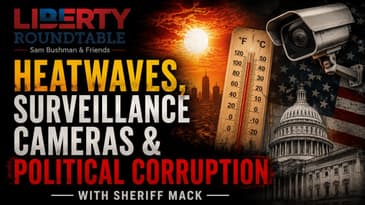
[00:00:04] Broadcasting live from atop the Rocky Mountains, the crossroads of the West, you are listening to the Liberty Roundtable Radio Talk Show. It's hotter than all get out in many places. Earthquakes, fires, they're all going on ladies and gentlemen. I've got a little trick for you to deal with the degrees.
[00:00:28] And then we'll talk about trafficking rings and license plate readers and, oh, Senate advances these people to lead the nation and Director of National Defense and all this kind of stuff. National intelligence, whatever. They got so many government leaders, it's not even funny. When are we going to really reduce the amount of government leadership we have big time? I want to know that.
[00:00:52] The Good Sheriff's with me, Sheriff Richard Mack, CSPOA.org, and his incredible book, The Democrat Murderer of America, Democrat Murderer of America in the First Degree, written by him and Daniel Perkins. A great, great book, intentionally provocative title, so provocative that I tried to write a press release about it. I can't even name the book. Or if I do, then they'll just say, no, we're not publishing it. And the divide continues in America as they try to bait Neil Gorsuch about if we're a Christian nation or not.
[00:01:20] He says, no, because we're not a white Christian nation. You know, when you start to put that all in there, it's designed to make, no matter what your answer, you're going to step in it. And they know it, and they've done it on purpose, part of the destruction of America. Sheriff, a couple of quick things. It's hotter than all get out in Phoenix. Over the weekend, it hit 118, 119 degrees. Death Valley hit hotter than that. I mean, it is crazy town weather. Now they're saying there's hot weather just continuing, continuing.
[00:01:47] There's fires all over the world in the United States and France and Spain, and it's just disaster. Then you got an earthquake hit in Japan, and we're getting our heads handed to us from a weather point of view, sir. Yeah, I felt that temperature yesterday. And still, the hottest it ever got while I've lived in Arizona was 127. And that was in Phoenix.
[00:02:17] And I remember my wife and I were going to eat at the Olive Garden. And the blacktop just almost burned your face while we were walking into the restaurant. It can get pretty bad here sometimes. But the weather worldwide is going crazy. You're right about that. The weather in Death Valley is the hottest in the world. The hottest it's ever got, believe it or not, 1913 from what I understand. 134 degrees, sir.
[00:02:46] Yeah, well, and Arizona was just seven away from that. So, but. All right. You know, I like the four seasons here, though. Except the summer one lasts a little bit too long. Amen. I like the four seasons where you actually get snow, though, Sheriff. Oh, yeah. Yeah. You got to have snow on Christmas, my friend. All right. Anyway, a little weather trick for you. Do you know how to quickly determine the difference between Celsius and Fahrenheit, Sheriff? No. All right.
[00:03:16] Here's the easy way you do it. You take Celsius. And you double whatever the number is and add 30. Or you can add 30. And add 30. It's not 100% exact, but it's close enough for discussions, et cetera. Okay. And so. Wait, give me the formula again. Double whatever Celsius is. Yeah. And add 30. Or you can take Fahrenheit and you can minus 30 and then divide it in half.
[00:03:45] So you can go the other way too, right? Oh, okay. Well, yeah. So let's say the Canadians say it's 30 degrees outside. And that's in Celsius, right? You got to double it. So 60 plus add 30. So it's about 90 degrees. It's really 86 factually. Right. Right. Or if you say it's 120 degrees in Phoenix today, just for instance, then you would drop 30. So it'd be 90 and you'd chop it in half. They would say it's 45. Right. So anyway, it's a quick little way to kind of understand the difference.
[00:04:15] I was talking to a Canadian yesterday and I couldn't, I mean, he kept saying, yeah, it's 30 degrees. It's crazy around here. And I'm like, man, you got to interpret that for me because I didn't know how. And so I looked up a way to quickly kind of understand it. You either double or divide in half, but you got to add 30 before you do it or subtract 30 before you do it, depending on which reference you're starting from. Right. Right. Anyway, there you have it. Just thought I'd share that with you. Hotter. Yeah. Yeah.
[00:04:45] So if it's 120 in Phoenix, it's like 45, right? Woo. There you go. All right. Senate advances Jay Clayton to the director of national intelligence. They voted 51 to 43 on this sheriff. They say the final confirmation vote expected soon, according to Reuters. Now, I don't understand why they voted and then there's going to be a final vote later. And I also don't understand 51 to 43. If I figure that out, 51 to 43, what's that? 94.
[00:05:16] That is correct. Where's the other six, man? Oh, they're out campaigning or doing fundraisers. Oh, well, they need to get back and do their job. Number one, we got to fire them if they don't. Number two, where the heck's Mitch? He's resting. He's kind of like the Scarlet. That's my biggest complaint, though, about both sides. Why do both sides just why do they stay until they die in office?
[00:05:45] Why not, Sheriff? Yeah. Oh, my gosh. Because they're killed alive. Hold on. How do you know that Mitch McConnell's even alive? I don't. See, and that, to me, is the biggest problem in America right now. When you've got one, I can't remember, one leader that related to national security somehow was missing in action for a while. He was sick or whatever. And then you have a senator, and you don't know where the senator even is. We don't know if he's dead or alive and this kind of stuff.
[00:06:13] You don't know, for example, details about the president that we ought to know, whether he's really from the United States or what his birth certificate is or whether they claim Michelle Obama's a man. I don't think I believe that, but I'm just saying you have all this different stuff. And the fact that we can't really know Bill Clinton has a black son, the black guy runs around and says, and we can't vet or run any of these things to ground. I have a real problem with it, Sheriff. Well, yeah, no kidding. Yeah, I do too.
[00:06:41] And this whole thing about, oh, the worst one to me was Ruth Bader Ginsburg. She knew she was dying, but she would not resign from the Supreme Court. Because they want to control the outcome, Sheriff. It was. It was politically motivated because she didn't want her replacement to be appointed by Trump. So she wanted to hang on. I'm sure the Democrats were trying to get the doctors to hang on.
[00:07:10] Oh, you know, keep her alive, keep her alive until, you know. And they just couldn't defy the laws of nature. And she passed away. And they still. There again, Sheriff. Yes, of course. But Sam, John McCain. Oh, the country just needs me so bad. I have to stay until I die. Mitch McConnell. Same thing. I mean, it just. It is. It is the epitome of the corruption of politics in Washington, D.C.
[00:07:38] And who's the pro-war senator that's now not with us? Lindsey Graham. Oh, yeah. Lindsey Graham. And so now Benjamin Netanyahu and Zelensky are coming to the United States to deal with Trump today and attend the funeral of Lindsey Graham today. And it's kind of interesting because now they're saying they got to promote war themselves. They can't rely on Lindsey to do it for them before Donald. So that's kind of an interesting twist the mainstream press is talking about. Well. And I find it interesting.
[00:08:07] I'm tired of a lot of that, you know. But I still don't know if the reporting is accurate. No, it's not. It seems like to me that Trump gets after Netanyahu quite a bit and vice versa. And they seem to be like friends that can disagree and fight and, you know, and argue with each other. So I don't know. I don't know if I get the whole Zionist, anti-Zionist thing, you know.
[00:08:35] And I do not like ever painting the entire Jewish race with a single brush because these Jews are these Jews. But they do it. There's lots of people who do it. And it's wrong. I don't like it. It's wrong. And they shouldn't do it. Everybody's their own man or their own woman. And they should be able to decide for themselves. And I've had Jewish friends and Jewish neighbors that are wonderful people, Sheriff. Come on now. Well, I've had Jewish friends who I never knew that they were Jewish.
[00:09:05] And how do you tell sometimes? I mean, you know, if they have. Do you need to tell, Sheriff? Do you have to know that? No. That's the whole thing. That's my whole point. I don't care. You know, what am I supposed to do? Go interview or vet people? Are you Jewish? Well, you know, here's what I think we should do. If they're Jewish or if they're Amish or if they're this or that or whatever. So now I've crossed from religious to other kind of things. Why does it matter?
[00:09:35] To me, see, if someone's a good, honorable, moral person, then they're a friend of mine. And if they're not, I want them to stay away from me because I don't want the carnage in the wake. That's all I can say. Right? Yeah. But remember Jesus when he was sitting with the tax collectors and all the other people. And the people said, why are you hanging around? Well, the whole need no physician. So you got to remember, Sam, us sinners, you got to invite us into your home. Yeah. There you go.
[00:10:05] Well, I don't mind sinners. I don't mind people that make mistakes, but people that want to do me harm, I'd like to stay away from. I'm just the don't take my stuff guy, you know? Yeah. Leave me alone. Let me live free. I'll let you do the same and that we can be peaceful and kind to one another. Let's do it. Did I include that quote in the book? If I didn't, I wish I had. I think you did in some way. I think you referred to it. I remember reading that. All right.
[00:10:32] When we get back, ladies and gentlemen, I want to talk about license readers. Automated license readers. They're entering a new phase. They're not going away, though, folks. I know people believe they are, but they're not. I'm going to tell you how and why and what. We'll talk about it with a good sheriff. You are watching Liberty Roundtable Live.
[00:12:21] Bushman. Automated license plate. They call them ALPRs, sheriff. And they're entering a new phase. They're not going away. Anytime soon, folks. Who controls the data is what the battle is about. So across the country, police departments are not abandoning the technology because it doesn't work. They are demanding greater control of how it's used.
[00:12:49] Recent actions in Los Angeles, Ohio, Connecticut, Colorado are showing a growing shift away from blind acceptance. And they're saying we've got to have tighter control of the collected data. We've got to make sure there's oversight. The debate is no longer centered on whether license plate readers help solve crimes. Most law enforcement agree that they do.
[00:13:16] They believe they're valuable tools for recovering stolen vehicles, finding suspects, supporting criminal investigations. But they want to shift the more fundamental questions. Who owns the data? Who can search it? How long is it stored? Can it be shared with other agencies? What safeguards exist to prevent, quote, misuse? How long is it?
[00:13:42] Several departments have suspended or ended contracts over this. Restricted data sharing and or moved to different technology providers because they want greater transparency, accountability, and local control. The bottom line is clear, folks. Licensed plate readers are here to stay. It's not a debate over the cameras or whether they do good or whether they should stay. It's over who controls the information they collect and how it's governed.
[00:14:12] Sheriff, I want you to weigh in on this because people say, oh, these cameras are unconstitutional. My response is it depends on who puts up the camera and what they're doing with the camera. I could put up a camera on my property facing the sidewalk and I can record anything I want to, right? Yes, you can. And some people do, actually. In fact, I do because I got a doorbell camera. Okay, yeah. And I know others who have set up even more.
[00:14:40] And I've got mine just so you know where it basically monitors my property, but it doesn't monitor the street, really. Yeah, okay. Well, and every time there's a kidnapping, everybody hopes, the victim family, they hope that the neighbors have all these cameras going so that they can go try to find their child. And then the next day they'll say, but I don't like all these cameras everywhere. You know?
[00:15:04] And so, you know, my biggest question is why are all of us forced by government to register our cars with the state? Why do I have to do that? And all of my information is available to every police officer who can just run them for no reason at all. He can run my plate just because I'm in front of him. He can run it and say he wants to see if I'm wanted anywhere. You have a fancy sports car, don't you, Sheriff? They do what?
[00:15:34] You have a fancy sports car, right? Yes, I do. All right, so if your granddaughter, pretty girl, gets in that sports car and drives to the store to get a drink, the cop can scan that plate, see the pretty girl and go, I want to know who that chick is. Well, it's, yeah, they could do that. But the thing of it is, it won't come back to her because it's registered to me. They won't know her. I understand. I understand. I'm just making a point, though, that they can get all that data, though. They can go, hey, the car's associated with her.
[00:16:03] Then they can eventually put more and more together, find out, hey, the car's related to Richard Mack. Then they can start to patrol the net and the social media and they can find, you know, eventually they can dig and there's enough information to put that stuff together. Yeah, no kidding. And it just really baffles me that we live in such an Orwellian society that all of us have to walk around or drive around with my property that I own. And some people dispute that.
[00:16:31] Even though you paid your car off and you supposedly own it, the state still claims ultimate ownership. But that's a story for another day. I don't know that I have any responsibility to allow that to happen, to divulge all my personal information. Yeah, but how do you stop it? At the whim of any cop. And yeah, and you know what some cops do? By law, you got to have a license plate.
[00:16:59] By law, you got to drive around with it on there. By law, they can, you know. So the debate becomes, you know, what is the law support? Do they have the right to take a photo of every one of these, put it in a private database? Plumb that database, share that database with other jurisdictions and the list goes on and on. You know, the governance of this is really the critical part that we've failed. What we do is we let the technology get ahead of the governance and we say, hey, roll out these cameras. And then we're debating on the back end after the horse has already left the barn on, hey, wait a minute. Who can share with who?
[00:17:29] Who owns the data? Who can search it? How long is it going to be stored? Can it be shared with other agencies? What safeguards are there to prevent, quote, misuse? You know, why are we debating this now after there's thousands of cameras all over the country? Don't we debate that before we roll out the cameras, folks? And that's the problem. That's what we should have done, right? No, it's all for our own good. So it's fine. Not. Yeah. The bottom line is clear, folks.
[00:17:56] They say to you that license plate readers appear to be here to stay. The real bad is no longer the cameras, but yet who's going to govern it? I don't know that we need to say that the cameras are here to stay. I think that we need to try to still route them out of our communities. If you want to go ahead and discuss the governance and get the governance in place in an appropriate way that protects our Fourth and Fifth Amendments, then I'll possibly discuss it with you. Until then, though, in my opinion, it's a violation of the law, Sheriff.
[00:18:24] Setting up a camera, collecting that data, storing it, sharing it for law enforcement purposes is a violation of what the founders intended about. Hey, if they're going to, you know, search and seize you, they're going to have to define what it's for, get a warrant, do all these things. All that's violated here, right? Yeah, it is. And, you know, some cops put it to use.
[00:18:47] A lot of times, like in Provo, Utah, where I was a cop, you know, the graveyard shift gets pretty boring. And even daytime shifts, it's boring sometimes. And I'm glad, thank goodness, that there are boring times and it's just quiet and there's not constant calls to fights or family fights or bar fights. Yeah, don't have time when that happens, Sheriff. Yeah. But you know what some cops will do?
[00:19:15] They'll really keep the dispatcher awake with constant, a constant barrage of running plates and kind of lower income hotels and motels. You know, the hotel room that costs $39 a night. Yeah, you rent them by the hour, right? You can, but they're cheapies all the way around. Sure. And they just know that if they go there and they just troll and they find plates, they might find outstanding warrants.
[00:19:43] Then they're like, hey, there's an outstanding warrant for this. And then if they say, well, you didn't have the right to do that, they'll say, yeah, you had a broken taillight or yeah, you whatever. No, there's nothing. No, they're just running them. They admit it. I know what I'm saying. If they ever try to dig in and prosecute and then have a reason that they got involved, they'll basically find some tic-tac reason to justify it. He doesn't really have to document it, but he probably would say, I was just looking for suspicious vehicles and this is where we find them.
[00:20:12] And that's probably enough reasonable suspicion right there. But that's where they find people hiding that are on the lam. And so they go and run them. And I've never heard of any of them ever having that challenge. But that's still the same thing as I was alluding to earlier. Why do we owe the police that registration that has my name and address on it?
[00:20:39] And so I've always wondered about it. It's a private property discussion at that point, right? If you find a guy wanted and he's got a kidnapped girl inside that room, you're going to be grateful that the cop did that to save your daughter. You know, so. There's a serious balance here that we're pointing to. And the reason that I bring it up now is because it was in the news.
[00:21:05] But I also want everybody to know on September the 11th coming up, we're going to have an event in Utah County in Highland highlighting this. And we're going to talk about surveillance and have a mock trial about surveillance. Sheriff Mack will come and speak. We're working on the exact topic, but it will relate to this as well. Well, he'll be speaking about his new book, The Democrat Murder of America, by the way. And so that'll be happening September the 11th. It'll be free. More information will be coming out about that soon. I really want to quickly get to this, though.
[00:21:35] Mark Lamb's in the news and he won. Sheriff? Yeah, he did. But I will tell you, Sam, as I spoke with him about all the accusations being leveled against him, I said, what do the polls show? And he said, I'm ahead by about 30 percent, maybe more. And he won by about 15 percent.
[00:22:00] So I'm wondering if it had an impact and if that means that's going to carry over now to the general election in a very staunch Republican area where the Democrat is going to make some inroads. In my mind, it depends on how much wings are to the allegations. And right now I'm saying somebody is innocent until proven guilty, sir. Yeah, but not in politics. That's for, you know, that's for police. Actually, you're right. I'm just trying to teach the right way to go, folks. But yeah, you're right.
[00:22:31] Yeah. So I don't know. I'm sure that he'll be OK. And I think he's handled it in a very politically astute manner. And, you know, he's backed off. You know, he just he just focuses on his campaign. And that was probably a smart way to go.
[00:22:51] You know, and he had his he had his agent actually write a letter on his behalf, a campaign letter saying how long she's dealt with him and what an honorable man he is. And, you know, I guess if they had to ask you and me about that, I would be able to write the same. Except you and I disagreed with him on one particular time.
[00:23:14] And that's when CSPOA was actually calling sheriffs nationwide and especially right here in Arizona to investigate election fraud. And he said he said he saw no sign of election fraud and he did not conduct one. Well, to see evidence, you have to look for it, which he did not. That's a fact. And I will say this, though, to those people who are attacking Mark Lamb over these allegations. Let's deliver proof.
[00:23:44] Because if it's there, I want to know. And if it's not, let it go. So I don't like these allegations in politics where we play games and barbecue people in the court of public opinion. I don't support that. No. All right, ladies and gentlemen, I submit we are a Christian nation, Neil. Just my opinion to which I'm entitled, by the way. Thanks for being along for the ride. The good sheriff with me. The Constitutional Sheriff's and Peace Officers Association. CSPOA.org. Become a member of the posse today, would you please? And get a hold of the sheriff's book. MurderofAmerica.com.
[00:24:14] I'm Sam Bushman. God save our constitutional republic.