
[00:00:04] Broadcasting live from atop the Rocky Mountains, the crossroads of the West, you are listening to the Liberty Roundtable radio talk show.
[00:00:15] Happy to have you along my fellow Americans, Sam Bushman, Liberty Roundtable live. The incredible interviews just keep rolling here at FreedomFest at freedomfest.com to learn more. Libertarian Conference put together by Mark Skousen and Company. Dear friends, thank them for all their work. People are running around having a good time coming off the stage joining Liberty Roundtable.
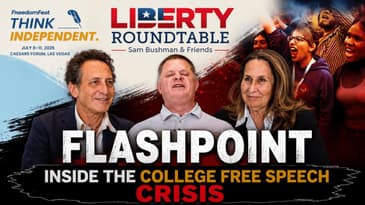
[00:00:42] It's a party to say the least, ladies and gentlemen. We're having a great time. People are learning from one another. People are debuting films, which is what we're going to talk about now. Flashpoint's the name of the film. It's a short documentary about 28 minutes and we're going to dig in with the director and the producers who are both with me now. Let's start to the left because ladies first, why don't you introduce yourself? Carol Polizner. I worked on this film with Vance Balding. I was a speechwriter and a writer. Published newspaper. What's the newspaper?
[00:01:12] The newspaper was called The Boston Trader. The Boston Trader, okay. And you're a speechwriter for who? Well, Citibank and some of the... John Reed and some of the executives. The executives, the EVPs and stuff. That was a while ago. What got you involved in filmmaking then as a producer? I've always loved film. I left Citibank a long time ago, raised a daughter and was ready to jump right back into the fold. Excellent. Van, why don't you introduce yourself, sir?
[00:01:42] Hi, I'm Vance Balding and I've worked in various film projects over the years. And then I kind of took a break and my daughter was going to... She's looking at colleges so I started reading about what was going on in college campuses. Sweet. And that led to making this film. So, is it really your brainchild then? Yes.
[00:02:12] Okay. And how did you get Carol involved? Well, Carol and I went to college together. Okay. And she was involved in journalism and various other studies there. And I majored in film and broadcasting. I love it. Okay. The film's called Flashpoint, everybody. Do you have a website for people to go to if they're not here? Yes. It's endogenouspictures.com.
[00:02:43] So, tell me about the film then. What's the whole point of the film? It's Flashpoint. Really, we see Flashpoints on campuses all over the country, huh? Yes. So, the point of the film is to examine what is going on in college campuses and is it helpful for students, a good education for students.
[00:03:10] And we interviewed a number of students, a number of professors, and we dived into the personal stories of some professors and students who got a lot of pushback for expressing their viewpoints, which were not, you know, which were somewhat contrary to the prevailing viewpoints on campus. Sure. So, when we talk about Flashpoint, let me ask you this.
[00:03:39] You know, I agree in America's healthy debate. Okay? I agree in the genius of America is for everybody to be able to express what they think and feel and believe. And, you know, out of that kind of cacophony of voices and thought and view comes genius, comes America, comes... Yeah. But then there's a line when we cross it to where we decide we're not going to listen. We decide we're not going to really engage. We're going to label. We're going to dehumanize. We're going to...
[00:04:09] Isn't that what Flashpoint really is documenting? Yes. Yes. Yes. Because of people's identities, they have pushed forth their point of view and have said we can't talk... First of all, they feel like they can... They're the only ones that can talk about their group. So, that limits discussion on that level. Sure. So, you get these echo chambers, right?
[00:04:38] Yes. And they don't welcome free discussion of these issues. And that affects overall education. Of course. Some teachers that we interviewed in our film were basically pushed out of their positions at Evergreen because of their... expressing their viewpoints. And they were tenured. How do you get pushed out when you're tenured? I thought tenured was supposed to be this protection that you get for well-served.
[00:05:07] Yes, exactly right. But if somebody's going to make your life usable day after day after day because of the things that you believe and the things that you say, they... You want to find somewhere else where you can be more costable. So, whether it's passive-aggressive or whether it's literal flat-out political violence, that's what we're seeing, right? Exactly. At different levels. Yes. The campus depends on the level. The people involved depend on the level. The propaganda rate at the college, how far they've gone along in that relates to that.
[00:05:36] Does it turn into political violence, though? Well... When you say political violence, it turns into protesting violence. Yeah. They... And disruption. These professors, their class was disrupted by a group of students that just showed up unannounced and took over the class and accused the professor of racism. When you tried to have a discussion with them, they said, no, we're not here to discuss.
[00:06:06] We're not here to debate. We know what you're up to and... And his life was threatened. Yeah. Yeah. Okay, that's what I mean. Now, when you threaten people's lives, you're bordering on... You can call it political violence. I don't like those precursors to violence, right? Right. I don't care if it's political violence or hate or whatever word you want to use, sexual violence. Look, it's a crime. It's violence. It's wrong under any modifier word, right? Yes. It's a crime.
[00:06:34] How much does the film touch on their side? Meaning, these people that are creating this political violence are creating these beyond debate, hostilities, etc. How much of their side do we get and does their side have any validity? Carol? We have tried to present both sides.
[00:06:50] We have re-interviewed professors and we interviewed students and the students who were leading the protest who were protesting kind of almost semi-violently against Brett Weinstein, who was teaching at Evergreen at the time. The interesting thing about it was they had never even taken a class of Brett's. He was just... It was all about him having issues with the equity program. So pardon the pun, he brought up something.
[00:07:18] They turned them into flashpoints and then before you know it, it's beyond recognition. There's this labeling this attack by people who really don't even know. Right. And it got out of control. Way out of control. So... But we spoke to both of them. We spoke to whoever would speak to us. A lot of teachers wouldn't speak to us out of fear of retribution. So that was difficult. And so that's where kind of when we talk about this political violence, at least that term, because now you've got fear of retribution where...
[00:07:48] What is it? Fear of violence? Fear of hostile... You know, fear of being let go. Maybe they break your bread bowl, which means you have no ability to support yourself anymore. That's violence, right? Doxing. Even though it may not be blatant, physical, it's still a form of violence, right? Doxing, threatening their children. Sure. That happened to a professor. It's kind of mafioso style, isn't it? Yes. Hey, Van, you better pay attention, my friend. We're gonna take care of you if you don't cooperate, you know, kind of thing. All right. Go ahead.
[00:08:20] So, yes. The teachers were threatened with doxing, disclosing their address, disclosing where they are, and... The names of their children as well. And some of the protesting students were dox. The students at Evergreen believed in their case so strongly, they posted videos of their protests on the internet.
[00:08:48] And in a sense, it backfired because it didn't... They didn't look great on camera in terms of their behavior. Sure. So, that was interesting. And that was part of the reason I think that both professors and students didn't want to appear on camera. They just didn't want the attention. Yeah, they're just like, hey, we've been down that road nothing. Yeah, right.
[00:09:15] Which, sadly, you would have treated it differently, but again, you're not given that chance now because of the climate that's been set, right? Right. Yeah. And also, the administration has made everything very difficult. And I remember having an argument with the person who was in charge of PR for Evergreen. And I said, you could... Because they were all over the internet. And I said, you can say why you... Gosh. This is your point of view. We want to hear what you have to say. They shut us down.
[00:09:44] They didn't want any part of it. Wow. All right. Did you guys dig into... You know, they always say follow the money, right? Right. You're digging into the money that's causing this. Why are we at this flashpoint? I don't believe... They want you to believe that it's just kind of like random or it's just kind of like, A, there's no leader and no head to this thing that it's just kind of everybody's just... But the truth is there's got to be money and organization behind it. Or it couldn't be happening so consistently on math, right? I don't know. I...
[00:10:12] Yeah, I'm not sure that we could pinpoint that at Evergreen or the people that we interviewed at other colleges. I do kind of feel that that might be going on in the pro-Palestinian anti-Israeli protests. Yeah. From what I've read... I'm saying the organization across the country where these break out all at the same time, it can't just be like flash mob random.
[00:10:41] This flashpoint's being brought to a brink. Somebody's continually raising the temperature and training people and funding this to happen. It's got to be or it couldn't be that organized. We have organizations like Turning Point that had sponsored the press watch list. So, and also they would come on campus to protest abortion, which is a really hot topic. Yes. Yeah, so that's... Do you think Turning Point is adding to the flashpoint? Or are they dialing it back?
[00:11:10] I think they're adding to it. But some of the other groups are also adding to it. I don't think anybody is. Okay. I really want America to get along. As I started out the interview, I basically said, hey, you know what? We really want to discuss things. We really want to debate things. It's okay to even have a little bit of vigor in our topic discussion. The founders did. We can too. There's nothing wrong with that. It's when we dial it to a flashpoint that we got a problem. How did we dial it back? Did you guys focus on solutions or what can we do to counteract a lot of this
[00:11:38] or prevent it from getting even worse? Well, it's very difficult. I think social media really contributes to it because for most social media, people go to hear the viewpoints they believe in. They don't want to hear contrary viewpoints. Sure. So, I mean, I think that students in high school need to learn about civics and the importance
[00:12:03] of free speech and being able to talk to each other when you disagree with each other. I think a lot of students nowadays, they arrive at, well, they have problems in high school, but when they arrive in colleges, they're not used to that kind of outlook. They don't, they think that free speech is okay if there's only one point of view being expressed. So, I see.
[00:12:33] So they misunderstand the whole term, if you will. Right. We had the head of FIRE and we had to beat him now, which is a national organization. Yeah, I'm only with FIRE, sure. It's a wonderful organization and the head of it is terrific. And he was, he basically was introduced to some of the worst party, the worst protest of the Christakis' at Yale. And that happened, that was quite a long time ago, but I think he's actually there. All right. Is Flashpoint going to have a 2.0?
[00:13:04] It's very possible, Dan. To me, 2.0 leads to solutions. Are you familiar with Braver Angels? Yes. Yes. So I think they're doing, do you think they're ratcheting it up or do you think they're dialing it back? No, I think they're a valid organizations and they are interested in including all different people with different viewpoints and helping them discuss things together. Sure. The reason that this is so dear to my heart is I actually created an, I wrote an article
[00:13:34] back in 2016 when this started to kind of escalate. I believe it started with Barack Obama, this division, but it certainly got accelerated under Trump. And I'm not here to blame anybody. I'm just telling you from a timeframe point of view. And so I wrote an article called a Clarion call for civility. Yeah. And that article basically talked about, we need to dial it back. And now I'm working on a book called a Clarion call for civility. And I've got a website, call for civility.com with a pledge that people can take to say, I'm going to dial it back and have respect for one another. Even if we disagree with views, we don't have to get to this.
[00:14:03] You know, we don't have to take it Jerry Springer, if you will. Right. Yeah. And so I really have an interest in what you guys are doing and why. And I'd love to see 2.0 focus on what can be done about it from an individual point of view, a family point of view, a local or city, you know, all the way up to the national or even at a world level. What can be done to dial us back and realize that, you know what? We're all sons and daughters of almighty God. Even if you don't believe in God, you can say, you know what? We're brothers and sisters in a world way. Right.
[00:14:31] And with that, we can learn to deliver our viewpoints in ways that are not personal, but that are, Hey, based on issues, based on principles, based on, and we can talk through these things. We can dial it back, have some dignity. We can agree to disagree agreeably. That's what I'm kind of looking for. And I'm hoping you guys will put together like a 2.0 that, Hey, dial back the flash plate. Well, we need role models too. We need effective. Amen. Sure. Yeah. Because right now, I mean, the whole country is so polarized.
[00:15:01] Everybody is running off in their own little corner. So they don't want to hear what anyone wants to say. They're not open to any other point of view. And so I think that's, and they think that's okay. And the colleges, how are you going to get an education if you're not listening to other people's points of view? I agree. And also how can you get an education if there's fear and vitriol and threat of violence or- To ask questions. Or other repercussions. Yeah. You bring up something, ask your question, next thing you know, you're ridiculed or mocked or even worse. And you are.
[00:15:30] And so, all right. Where do people get the film again? Where do people watch it? We are in the process of looking for a distributor for it. So right now, we're presenting it at various film festivals, including this one. Yes. And I guess they should go on our site to see where it's going to be next.
[00:15:54] And so, I'm going to be here. And I'm going to be here. I'm going to be here. So, I'm going to be here. Thank you. I see you. Thank you.
[00:16:24] I'm going to be here. Thank you. Thank you. Thank you so much.