

[00:00:04] Broadcasting live from atop the Rocky Mountains, the crossroads of the West. You are listening to the Liberty Roundtable radio talk show.
[00:00:23] Happy to have you along my fellow American Sam Bushman for Liberty Roundtable live at Freedom Fest, Kyle Seraphin with me. And you know, Kyle's been around forever. If you don't know who he is, you're living under a rock. Other than that, we'll just say welcome, sir. Well, thank you. I'm sorry for the rock people. So tell me this, you know, you got your start at FBI, then you became whistleblower, then now you've done a gazillion things since then, right? But tell me about the FBI, because you know what? We all want to believe the FBI is good. It's just had scandal after scandal after scandal.
[00:00:53] Then you had, you know, Cash saying he's gonna go in there and fix it. Cash promised a lot. I'm gonna leave the next part to you. Yeah, he did promise a lot. I think he failed out of the job right away. I think that both he and Bongino are probably maybe a generational disappointment would be the right answer. They had a lot of promise coming in. And unfortunately, they didn't fulfill any of the things that they said they were gonna do. Why? What do you think happened?
[00:01:16] I think that the answer is different for each of them. And as best I can guess, I think Cash Patel, and I was just talking to a libertarian guy in the other room. In probably November or December of 2024, so Trump had already won, and he was looking for his cabinet.
[00:01:41] He was looking for the sub-cabinet positions. And Cash was talking to me about whether or not he could find his way into the administration. I said, where do you see your belt going in there? And he said, I would do equally well as the director of the CIA or the FBI. And it rubbed me wrong at the moment, and I kind of moved on from it. It's just one of those things goes in one ear, and I kind of thought about it, and they went, okay, fine. Yeah, because you're saying, hold on. But those are very, very different things. Just so I understand, what you're saying though is he didn't really care where he went. Correct. Is that your point? And it's twofold. That's part of it.
[00:02:09] He wanted to be somebody. So that was clear. Uh-huh. But you said it. Instead of I've got a mission, and I'm ready to take action of that mission. Correct. More like I don't really care, just put me somewhere. I just want to be a somebody in this administration. Keep going. I don't mean to interrupt. Yeah, right. The scary thing about that is if you say I would do equally well in either one of those places, it tells me you probably don't understand either of those places. Sure. And so you probably wouldn't do well in either of those places. And what we've seen is a lot of big talk, entire books written about it, including by Cash Patel. Yeah. He made a lot of promises of what he was going to go in and do.
[00:02:37] And what I've seen him do is reluctantly do some of the reforms that myself and some of the other whistleblowers were pointing out, which was we gave him a roadmap of what he needed to do to regain control of the agency. And it's my supposition. He's never done that. What he's done is roll out a couple of PR wins whenever he's got himself in kind of a tight spot. But he's doing what the FBI has always done. They go after the counterterrorism priorities. They target people that are of convenience and they'll do the same thing the minute he's out, which I would imagine is either going to be after the midterms or it'll be in January of 29.
[00:03:05] If we end up with, you know, President Newsom, I don't see it being something that's that's my darkest sort of thought is like if things don't get performed, then people, especially like young Americans. I know. Look and say, right. If you don't do what we said. Yeah. Then why would I care what you do? Like who else is in charge? I'll turn it over to the other team. And if I have nobody else I can really pitch for that'll do it. Why? Why am I even here? That's exactly right. All right. So let me ask you this. So you mentioned the fundamental different missions of the CIA and the FBI.
[00:03:33] Tell me how you think they are. Well, one of them is supposed to be foreign and the other is supposed to be domestic. That's like the simplest answer. Sure. The problem is, is I think there's a big disconnect for Americans in what the CIA is. They don't necessarily know. But more importantly, the CIA doesn't kill people domestically, at least not very often or that we're very aware of. The FBI does inadvertently. Does the CIA even know what it is? The CIA does. Yeah, sure. Of course. So, I mean, there are parts of the CIA that do operate domestically. They have a whole group called National Resource and you can look into it and they've got a Wikipedia page.
[00:04:01] And you can find out that there are domestic operations of recruiting Americans who travel overseas. But in theory, the agency's job is to look overseas and try to figure out external threats. How do we mitigate them? How do we collect on them and then make sure that they don't come back here? How do we develop relationships for Intel and so on? Yeah, all of those things. And so some of those people are going to be domestic, like, you know, people that are in business, people that are foreign travelers, people that are in missionary groups that give them access to places they want to go that are difficult. So the CIA's mission, it actually scares me much less.
[00:04:28] And I've talked to guys in the CIA. You just sat down with with Jim and Jim Erdman's position to me very early on was that I am far more worried about the FBI than the CIA. He was at the CIA. I feel the same way. I was more worried about the FBI than the CIA. So when you started out, you thought the FBI was fine? I didn't know any better. Honestly, yeah. So I started there in 2016. I showed up and, you know, the immediate disconnect between what the FBI is billed as and what it actually is.
[00:04:53] It's kind of like when you go into the military, you go off thinking that you're fighting for America, you get out in the world and you're disenchanted and you're going, what the hell? What am I doing here? That's a great, that's a great analogy. It felt very similar. And I went into the military. What happened? Show me the progression. So I got into Quantico in July, sorry, June, late June of 2016. And within the first week, I was a little bit kind of disappointed, but you know, it's an academic environment. It's not quite the same thing. Yeah, wait until I get in the real world. That's right. So I gave my time at the Academy kind of the space to work and it talks a good game.
[00:05:23] I think the thing that the Academy at Quantico does better than anything else is it tells FBI agents that they are elite, that they are part of a premier organization, that they are standard bearers for something that means something important and has a storied history, but they don't necessarily go long on teaching. And so the great example is I learned exactly one federal statute the entire time I was at Quantico, which was five months. One.
[00:05:53] And in the course of like an official, you know, investigation, but this is the everybody else, but you can. Yeah. So the crazy thing about it is, is that it was used regularly and cited regularly. But when I would go in and I was an adjunct sort of teacher, I would go back to the Academy and kind of offer as a instructor there. I would teach emergency medicine because I was a paramedic for years and I'd go in there and tell people, it's like, hey, did you guys learn any statues? Because I didn't learn any when I was here. And for the years afterwards, while I was in the D.C. area, five more years, I literally never heard another student say, yeah, we're being taught up on these federal statues.
[00:06:24] It's not part of the Academy. So what they do is they teach you basic con law. They teach you some tactics and kind of like, let me show you now you better be an expert. And that's kind of scary. They teach you how to shoot, which they do a very good job of. And then they send you off in the world to learn how to be an FBI agent after five months of really spending a lot of time waiting for your family. Don't they need to spend a bunch of time on de-escalation training? There's here's the crazy thing about the FBI agent. Am I crazy for this question? You a little bit, maybe a little bit. The FBI only in involves themselves with people that they already know they're dealing with.
[00:06:52] So the investigations are meant to be long term. It's not police work the way that people think about it. It's law enforcement, but it's not the same. It's long term investigations. So if your local cops are doing traffic stops and they're the ones that are, you know, interdicting people on a highway and then finding out that they have drugs or they've got some child who's been abducted. And they go and they dig up the, you know, sort of up the chain. The FBI would take that piece of information more like a detective unit. And they're doing long term complex investigations that nobody else can do. So theoretically, they're doing financial fraud.
[00:07:22] They're going after white collar and medical fraud. They should be looking into, you know, organizations complex, whether it be, you know, RICO or whether it be what we call transnational organized crime. And the FBI is really the only group that's supposed to be looking across state borders to do that. Now, in reality, they're like every other federal government or every other government in general, which is what's the shortest way to get the accomplishment. And so the FBI cuts a lot of corners. So, for example, the medical fraud, there's an entire medical fraud division that deals with just medical fraud.
[00:07:50] And they end up just doing drug cases because it's way easier to go after pill mills than it is to look into people who are billing the government in sort of false ways. Yeah, but it's way better to do the honorable thing and focus on what your mission is and focus on the bigger picture. One would think that that's the case. The other problem is, is that, as you say, a bigger picture. Most Americans think the FBI is involved in criminal investigations primarily. And I would say at the best case scenario, it's 50-50 national intelligence or national security. And then the other 50 percent is criminal. It might even be more.
[00:08:17] So you've got two sides of the house on the national security side, which is going to be counterterrorism, counterintelligence. None of those have to allege a crime. And when people realize the FBI can open full investigations into other Americans, not because they committed a crime, but because they fit the pattern of some sort of, quote unquote, threat. But now you're in this really weird space where the pattern of investigation is no longer linear, where like crime happens, we find out who it is. Do you believe the FBI is criminal when they cross that line? So they're not, at least not by the criminal statute.
[00:08:45] But are they abusing the trust of what the Americans think? 100 percent. So when an American says we think that's criminal, that doesn't mean there's a technical lawyer term. That's right. It means we believe what you're doing is wrong and it needs to stop. So I would use the broader explanation. It's either illegal, which is what you just said. It's immoral or it's unethical. And all three of those kind of play together into the things that should be the do not cross. You're hiring people that have discernment, but I don't think they do. But I think a lot of people just keep their job. But do you believe, though, that what you're taught?
[00:09:13] I mean, you're taught to be a rock star. There's no real countermeasure to what you do because you're too good. Is that what fuels it? I think it's fueled by the oldest thing in the book, which is that government begets government. Government's job is to make sure that government continues to exist. Nobody's ever been promoted inside any government agency by reducing the size or the headcount. Sure. So that's just the nature of government. The FBI just basically gets these requirements. They get funding and then to meet the funding. This actually goes a little bit more convoluted than you probably want.
[00:09:40] But there's this process called integrated program management, which is essentially a quota system. Yeah. Which means we better spend it or we'll lose it. It's that and it's also that I think it was in 2012, maybe 2014. McKinsey and Associates, the consulting firm, they tried to create a series of metrics that would be able to hold the executives inside the FBI accountable the same way you would like corporate executives in a for profit company. So they gave them metrics to meet and they were all these different things internally.
[00:10:08] Like you have to meet these deadlines and your squads have to do this things. But they evolved into like you have to open this number of cases. You have to use these sophisticated techniques and this investigative stuff. So we lose sight of the mission. What they do is they say, how do I get my bonus? My bonus is going to be 30, 40, $50,000 a year when you're making 200 grand. That's a lot of money. And so to get that bonus, I got to hit all my metrics. And so they end up chasing the metrics and it gets very procedural.
[00:10:31] And this is where you end up getting the problems that people have seen in like, let's say the Gritch and Wichmore case, where they're incentivized to create counterterrorism cases. And what seems like out of whole cloth, because it's way easier to find counterterrorism if you're making it. If you're entrapping people into it, maybe not legally, but morally, the things that we would consider, like you said, the average American would consider it to be entrapment. There's a lot of that that goes on in the counterterrorism. I think I would get American in mind. We're not caught up in all those words and technical terms. This slices this and that means that. Right. We're not doing that.
[00:11:01] We're just simply saying you're wrong and you've got to stop doing that. Right. And they're perversely incentivized to not listen to what you're saying. You might say that's too simplistic. I understand. But that's where most American people are. They're not in there. This is why these guys kind of dodge out whenever they go in front of Congress. You've seen people like Chris Ray go and do testimony. And when you see them, you go like, oh, what are they doing? Why does he keep saying these things? And how come he's not perjuring himself? And he's just shading around with the language that it's technical and accurate enough that he's not going to get jammed up. When in reality, any normal person would listen to it as a layperson.
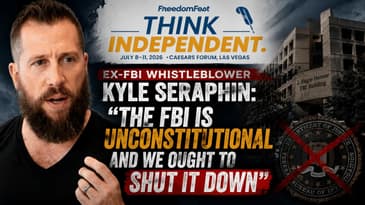
[00:11:31] They would go, you're clearly on the wrong side of this. You're clearly violating. So they're technically based on the law, though. They're not. Correct. I understand that. And I know that's a problem. It is. So what do you think needs to happen with the FBI? You know, Cass said, hey, let's get let's get rid of it. Let's take it out of D.C. and put it around the nation. Yep. Simplify it. Bring it close to the people. I kind of think the FBI is unconstitutional. We ought to just shut that sucker down. What do you say? Yeah, I tend to agree with you. So as a general answer, I say yes. A lot of people will fight that because they say you have to have an FBI. Who else is going to do that? No, you don't.
[00:12:00] I think the argument is, is that you'd have to go upstream and say, why was the FBI created? Sure. Why did it get created? And then is it still doing that purpose or does it have a new purpose? And my response, even if it did get created, if it didn't get created constitutionally or supreme lawfully, then we if we really need it, let's create it right. Then let's let's dissolve it. Let's create it right and tie it to its core mission. So I totally agree with all that idea. I think that's the right answer. Unfortunately, I also live in the reality of like, no one's going to do that.
[00:12:29] There's no political will to do any of the things I'm talking about. So there's the ideal that we want to teach to. And then we'll live with the real. Let's talk about it. All right. So the real things you can do are you can divorce the national security piece from the from the criminal investigations. And so we looked at it initially. This is a post 9-11 phenomena where they basically try to decide whether we go with the sort of MI5, MI6 model, whether we do this hybridized thing. We ended up with probably the worst answer and the worst case scenario. And that's been proven out over the last 24, 25 years.
[00:12:55] It's pretty clear to most Americans that the things that are housed in there, I'll make the quick argument. You should not have a group of people that have a national security and a national intelligence mandate that also have the ability to charge you with the crisis. And do so with no checks and balances. And this is exactly why, right? Because what is supposed to happen is if you were going to do something and charge somebody with a crime, there's due process. There's the requirements for warrants. Exactly.
[00:13:22] What we've seen is, is that they get access to certain things under one way, like they'll get it under the national security aspects of it. They'll go on that side of the house. Once somebody who's a federal agent who has the charter to go out and arrest people for federal crimes knows something in a lawful way, they're never going to unknow it. So if I find out by looking into you because you're a quote unquote counterterrorism or a counterintelligence threat, and I go digging into your emails, your bank accounts and otherwise, once I know things about you, like, oh, well, I was looking into Sam because I was really worried he was selling this out to the Chinese. But it turns out he's just doing mortgage fraud.
[00:13:52] I still will know that you're doing mortgage fraud, and I can go build that appropriately on the criminal side if I want it. And that's too much power, and it actually doesn't end around what they're supposed to do. And what we really need to do is look at due process. We really need checks and balances. And that's why I say that we need to basically destroy it and build it from the ground up if we say we need it. And I'm not here to say that's not true. Yep. I'm just here to say if we need it, let's build it in with checks and balances to where it has the restraints necessary to make sure there's due process for everyone. Yep. And to make sure the Fourth and Fifth Amendments and, you know, et cetera, are not violated.
[00:14:22] We can do that. It's possible to do that. It should be. I think that what we see is that I think our systems are inherently broken at this point. So I'm kind of a people will call it a black pill. I think I'm kind of a pragmatist and a realist. If you walk back, I think we're probably in the fourth iteration of what America is, that it started off and it was underneath the Articles of Confederation. And then we had the Constitution. After the Constitution, we had sort of a civil war situation and a post-American civil war. That moved right up to either 1913 or the civil rights.
[00:14:51] I don't know, somewhere in there. But between the 1913 reforms where we had the Federal Reserve come in and we had the 16th and 17th Amendment, which were devastating to the system, like the core system. 1984 mixed with rules for radical. Yeah, we've moved into this iteration of things that is not recognizable as the original republic. And so I don't think there's anybody that's willing to go up and say, oh, we have a functional system. We can propose an actual fix to this governmental entity.
[00:15:16] We're sort of in that space where Ronald Reagan, he actually said, what, like the closest thing to eternal life on Earth is a government program? Well, let's get real credible on an example of that. In the 1990s, we almost got rid of the ATF, if you recall. Sure, we almost went away. We almost got rid of the IRS, too, by the way. Well, I was told that when we voted this last time that we were about to get rid of it, and I was all for it. Psych. Because the other thing is, if you get rid of the IRS, you end up getting rid of about 90% of the government, which I don't think we need, right? That's where I'm at. Yeah.
[00:15:42] The problem is, is in the 90s, we learned, like, okay, well, there's no home for the ATF. They have this weird law enforcement mission that they basically created, and they're a tax agency, and Treasury doesn't want them. And DOJ picked them up. Even though they were thinking about getting rid of them, what did they do? They did Waco. They did Ruby Ridge. They made a huge mess. They killed people. They had the FBI come in and clean up after them. And there's no accountability. None. In fact, the people that did the deeds are promoted. That's right.
[00:16:12] There's not even a purpose for this thing. It can be picked up by other agencies, and it doesn't need to exist. And we can roll the guys in that work there. But the people that were the executives in those agencies defended their little fiefdoms the way that every single federal agency ever has. As far as I can tell. They all go back, and they do the same thing. They say, this is mine. I worked my way to the top of this organization. I'm not going to do it again. So I'm going to make this agency relevant to you. So we put some reforms in place, Kyle. What would they look like? I'm asking you now. What proposed? I don't think reforms. That's what they say.
[00:16:42] Yes. And what do the reforms look like? Well, we're going to make sure this doesn't happen again. They say that they have these platitudes. At the end of the day, we just did the same old. The question is, who watches the watchers? That's why I say the only way is to destroy the organization, create it from the ground up properly. Yeah. And it'll only happen. So we've lived 250. We're in 250 now, right? 250 years, right? What do you think the next 250 looks like? Is it just going to be a tyranny? I don't know if we may get to another 250. I think the next couple of years are going to be very interesting.
[00:17:09] I think there's a decent possibility that the federal structure, the scaffolding that holds up what we're doing right now collapses under its own weight. But there's obviously technological outliers that could come in and disrupt that. I don't know. I kind of worry. What I recognize now is a guy who worked in the federal government at a pretty low level, saw a lot of things, was aware of a lot of things. And I'm kind of a thinker. And then also saw a government tear me come at me when I said, hey, I'm not going to get this shot. Like, I'm not going to get a COVID shot. I have religious objections to it. And by the way, you don't want to hire me. You don't want to keep me on the payroll.
[00:17:40] That's fine. And they looked at me like an enemy. And they gave me another chance to kneel. They said, well, just put this thing up your nose every 72 hours and put a mask on, even though everyone else is getting the disease. And I go, you know what? I'm not going to do that either. I'm not going to discriminate against myself. And so I was, you know, sort of PNG'd, kicked out of the agency over that and the whistleblower stuff at the same time. So I look over and I go, I know what the system does. And a system is what it does. It only can be looked at how it comes out. I kind of just focus on the things that I know I can handle. I think it might fall apart.
[00:18:06] Honest to God, I think that local warlordism is a whole number real world possibility at this point where we go back to a devolved version. And that might not be the worst thing in the world because you might be ruled by like the states and the counties again. Well, I predict you're right. I pray you're wrong. And I know this. It would be ugly. If we have adherence to the supreme law of the land and we obey it, we can have, we can preserve this nation.
[00:18:27] If we decide that we're not going to pay attention to those fundamental checks and balances and principles, if Congress is continuing to be derelict in their duty, if the president continues to seize power, if the courts continue to waffle and write opinions that just tightrope walk, whatever you want to call it, to where, you know, it's not going to work. The checks and balances have got to be enforced, insisted on, or it will not work and it will fall apart. So that's my kind of statement is I believe we've got to have a restoration or a preservation of these fundamental principles.
[00:18:56] And when we do, the country works well. When we don't, the country melts down. So my pragmatic and sort of, I don't know, we'll call it a realist view. The realistic and somewhat pessimistic. I mean, I understand that too. My experience definitely tainted the way I look at things. But I'll say that the best predictor of the future is past performance. And we've seen that that has not been the case. And I don't see a huge appetite. We've got a man right now who might be dead in the Senate and doesn't want to be notified that he didn't make it.
[00:19:24] He's been, you know, I was a paramedic for 10 years. I've done CPR on people in their 80s. They don't live. Just overwhelmingly, I think they said nationally about 4% of people will live after a cardiac arrest with CPR. Even if they're resuscitated, they got about a 4% chance of surviving 30 days. The odds are is that someone like Mitch McConnell is in a really bad spot, potentially brain dead, certainly never going to come back and like he's not going to do a jig on the floor of the Senate ever again. Right? We can kind of realize that.
[00:19:51] And there's still this massive insistence that we have Scott Jennings going out and talking about that he's still alive, that he just had a phone call with him. He's talking about Ukraine and all the important things. Let's put that phone call on TV then. A hundred percent. I think we have a system that basically has encouraged lies to the American public. And people want to say, it's my guy that's lying to me right now, so I'm cool with it. And we've done this sort of tribalistic thing as opposed to saying, what is good for America? We can agree. As long as we agreed on what the goal was. And you set a goal like that.
[00:20:20] This is the same law of the land maintains that. We don't have that anymore. I agree. And I don't think the American people as a tribe look at it and go, ah, we all want the same thing. We're just arguing about how to get there. We need to learn that. Nobody even agrees that's a good idea. And certainly not the people that are in power, as far as I can tell. Unfortunately, you're right. All right. We got to wrap up. But tell me about Kyle Seraphin Media for a minute. Yeah. You guys can find me. It's kylseraphonshow.com. I do a daily podcast where we, you know, sprinkle in a bunch of humor, some mediocre to okay impressions of people that I don't like, which is essentially everybody that's lied to the American people. Right.
[00:20:50] Well, whose impression are you going to do for me now then? Oh. Let's see. I do a Mark Levin pretty frequently. Why don't you do a Mark Levin? I do a Mark Levin. I'll be more flitting for you. Yeah. Mark Levin. He's only mad. And he's mad at what's going on right now. And he's just telling you. If you don't listen to what he's saying, then he's going to yell at you. I think he's telling you. I think you just need to listen to Hillary. He sounds a little bit like the aliens from Mars Attack. No, I listen to Hillary. I think if you listen to Hillary. You give up. You give up on life. You might double tap yourself in the back of the head. Oh, boy.
[00:21:19] We have another Arkansas on our hands. It'd be crazy. It could happen. Ladies and gentlemen, Kyle Seraphin. kylseraphonshow.com. Check it out. He's here. He's a whistleblower. He stood tall for his rights, for his God-given ability to not take the jab. It was a Fauci facade from the beginning. Ladies and gentlemen, we don't want to take the clot shot. We want to be free to choose as we will. And that's why Kyle's here today. Is that fair? That's fair. All right. What would you say to the American people if you could say anything you want? I got six Fs. You ready? Focus in on your faith.
[00:21:49] Focus in on your family. Focus in on your fitness and your firearms. These are all within your own control, within your own house. You should probably work on either food or farming. Make it sure you store it or make it sure you're growing it. And then lastly, if you're not having fun and laughing about it, you're probably screwed too. So those are the six Fs that I live by. And those are F-bombs that I like. Ladies and gentlemen, thanks so much, Kyle. Yeah, you appreciate it. Sam Bushman for Liberty Roundtable Live. God save our constitutional republic.