
[00:00:04] Broadcasting live from atop the Rocky Mountains, the crossroads of the West, you are listening to the Liberty Roundtable Radio Talk Show.
[00:00:14] I have you along, my fellow Americans, Sam Bushman, Liberty Roundtable, live, promoting God, family, and country on your radio and TV for 30-plus years, partnering with our dear friends at Liberty United for this incredible interview.
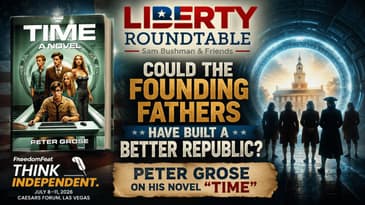
[00:00:36] So we've got Peter Grose with us. He is a financial advisor by trade. He's written an incredible book called Time, and the book really chronicles could the Founding Fathers possibly have built a better republic. We're going to dig in right now. Peter, welcome, sir. Thank you. Thanks for having me. All right. So it's a great question. It's a fair question. And the answer, I'm sure, is a little bit nuanced. But let's talk about first, how does a financial advisor decide to focus on this?
[00:01:06] Well, that's a good question. Why I wrote the book, I studied economics. I fell in love with economics, undergraduate at Auburn University. Not the Canadian kind, right? No, I bumped into the Mises Institute at Auburn University. Yes, sir. And I was fortunate enough to meet people like Marie Rothbard. I met Ron Paul in 1986. Okay. Not long after.
[00:01:30] I got signed copy of Henry Hazlitt's book from him and met him in person. So I've met a lot of these people. I went to grad school at George Mason and had lectures in macro from Mike, micro two, in grad school from none other than the great Walter Williams. So I've been in this and passionate about it. And so then I... So you've got creds in the academic world like I've got creds in the redneck world, ladies and gentlemen.
[00:02:00] Other than that, we're with... Okay. And so that those creds, I... Instead of going off and becoming academic and doing... Following through with that, I wanted to... I had a wife and we wanted to raise a family. And so I went off and became a financial advisor. So I've always wanted to contribute something to the... All this stuff I studied and was passionate about when I was in school. How is that, Sam? Is that a good enough reason? Absolutely. And the book's called Time.
[00:02:29] I'm going to say, Isn't It About Time? To discuss this, ladies and gentlemen. So you put together a novel. As far as I can tell, it's kind of a little bit fiction. In a way, it's a little bit more reality than we might want to admit, right? That's exactly right. There's conversations. It is a fiction, a proper fiction. I mean, it's got characters and story and dialogue. But the dialogue and narrative that goes along hits a lot of very deep top subjects.
[00:02:56] I got an unbelievable review where the guy, the person wrote that I did an amazing... He thinks I did an amazing job of combining such dry topics and making them interesting and seeing how important. Well, some great storytellers understand this method, this idea of, hey, it's fiction, but yet we're going to bring reality into it. It allows us to put people in places and times and circumstances to get the inside skinny, to be in the know, to know incredible historical people, people that do these different things.
[00:03:26] Ron Carter wrote a book about America, too. It's actually nine volumes where he does this historical fiction kind of thing around the founding era and the Revolutionary War and everything else. It's called... Ron Carter writes the book. It's nine volumes. It's incredible. And he does this very well. And what it really does is it makes stories sync. Yeah. It makes you want to read it, right? Right. Well, that's what I hope. I'm hoping that people will want to go... His book is called Prelude to Glory. Oh, my God. I should read it.
[00:03:55] Yes, you should. This book is available on Amazon on Audible. They got me this guy. I found we got to sample like four different... Sure. Paul Nichols from San Diego did a great job of narrating the book for me. So it's available on Audible, too. It's kind of nice. All right. It's just called Time. Yep. That's it. All right. So tell me... Kind of lay out the characters quickly. Give me a thumbnail of who am I going to be following in this book?
[00:04:21] Oh, it's a good question, Sam, because the first prime character is a gentleman by the name of Harry Brown. And if you're as old as I am, when I was inspired, there was the great Harry Brown who wrote the free market libertarian works on gold and such and ran for the presidency of the United States on the libertarian ticket. Back to the day. Back, it was Ed Clark, then David Berglin, and then it was Brown. Harry Brown. Harry Brown is... This one is with B-R-O-W-N, without the E. Yeah.
[00:04:50] But it was inspired by that. And his friend is a guy named Simon McPhee. They have a chance meeting with another guy by the name of Linus. Linus is studying quantum mechanics and quantum physics for his PhD. And he become... The three of them become intrigued in the ideas, talking about the fact that they could have
[00:05:14] made our republic, when they see the state of the country now, how the constitution has been... It's basically violated every step. So these three, how old are they then? They're in their 30s. They're all out of college and they're in their 30s. And they are... Passionate as professionals, if you will. Yes. Except for... Well, they're late 20s, almost 30, because Linus is in his PhD years. So they're almost 30. That's what they'd be.
[00:05:41] And the interesting point about the two characters is that Harry, while he believes, and he's a bit of an optimist, that they could have done things different, his friend Simon McPhee agrees with him on all his economic principles and libertarian values, but disagrees that it would make any difference. He really believes that no matter what they did, these evil people that desiring power will
[00:06:08] usurp, go around, or abolish the constitution or the laws to get power. Sure. Negate, circumvent, whatever it takes. Whatever it takes. I got it. That's the story, and it goes into that all. All right. So give me the website so people can follow you. You can buy it on Amazon, look for time. Yeah. The place to find it is on time. You can look at it on YouTube. It has a channel for the time, the novel, time, a novel, and Facebook. Facebook, it's got real things like this will be on it. Okay. So interviews covering the book.
[00:06:37] Yeah. Short, shorts and commentaries from different people. And yes. All right. So I've got questions for you about the book. People can look it up and read the book. We want them to do that. But the question is for you is, did you start out with a certain premise and end up with something else? You know, not really. It, it, it, it, it, I did have to start with the ending in mind and I knew it, but I'll tell you what, I, what's interesting.
[00:07:01] This is my first novel and it changed me, Sam, because I was amazed how, uh, how, as I went along, the story developed, the characters developed. It almost came to you. It did. And it's funny because now I watch movies differently a little bit. You know, I don't mean to be conceited and say, well, I'm an author now, but you know what, Sam, I'm going to tell you, it's a little bit like that. It's changed me a bit. I, I, I, uh, because I, I have experienced it and it was challenging. Sure.
[00:07:29] Were there any incredible gotchas along the way? Discoveries, gotchas where you're like, whoa, I didn't realize that. You, it, it, it was in, in the development of the character, Simon McPhee, who has the name, when every time I would look at things that I thought would make a difference, I realized, uh, the possibility of how, how manipulative and how, one of the things I came to during the
[00:07:56] book was how governments at any, in power state federally, mostly their goal, their way of controlling power. They're obsessed with control and power. And to do that every step of the way, they look for ways to crush the individual and empower groups. That's so device entities work. Yeah. Divide and conquer divide and control.
[00:08:22] And so that's why we have income tax on the individual subsidies to the corporations, uh, that when you buy health insurance, you can buy it through your employer and bypass income tax, state tax and payroll tax of 15.3. If you want to buy it on your own, you're using 50 cents a dollar. Yeah. It's a way to control and it's a way to force the central over the independent in this. Okay. Right. Let me throw out my idea and I want you to respond to it.
[00:08:51] Then we'll let you promote the book one more time and let you fly. Okay. So I'm going to maintain that I'm super Simon, Sam. Okay. Super Simon, Sam. Oh, Simon, Sam. Okay. Okay. So I'm Simon in your book, but I'm Sam. So I'm going to take it further than Simon might even. I don't know. Okay, good. That's why I'm saying I'm super Simon, Sam. This is excellent. I got it. All right. So I maintain to you that there's no way on this earth they could have built a better republic. And let me explain to you my reasons why you can agree or disagree. It doesn't matter because I'm Sam and I can think what I want.
[00:09:20] So this is a libertarian conference. Yeah. We can agree to disagree agreeably if you want. Okay. That's perfect. But here's my idea. I believe that the constitution, the declaration of independence, the bill of rights was inspired by almighty God. And I believe it should be akin to scripture. And I believe that the, these documents should be the political religion of our nation. And I believe that they are not perfect. I'll be the first to illustrate. They're not perfect. However, you have compromise. You have opinions.
[00:09:49] You have, and to bring these people together with such skill, with such knowledge, with such historical context, with such relevant experience and, and bright minds to study history and incredible eloquent writers. I beg to say, we might not even have equivalents today. And they came together and they almost melted down many times and they argued and they fought and they bled and they sweated and they gave their lives. They lost more battles than they won. And I keep going, right? Forever. Right.
[00:10:19] And at the end of the day, though, they had people say a prayer to almighty God. And Ben Franklin, who's not even really a religious guy, decides he's going to be religious and it matters. And he says, hey, can a nation rise without his aid? And at the end of the day, it's not perfect. But any exploits you can point to, I would submit to you that if they did something else, you'd have a different exploit to point to. And at the end of the day, to get these people all in a room and get them to agree and to
[00:10:44] kick off this grand old experiment that's lasted for 250 years is incredible. And it's never been done in the history of the world. And if we adhere to the principles, it works incredibly well. And if we don't, it fails. And we see it failing now because we're not adhering to the principles, not because it isn't a great experiment. But I believe personally, and this is just my view, that the Constitution, the Declaration of Independence, the Bill of Rights, the Founders Notes, the Federalist Papers, the Anti-Federalist
[00:11:11] Papers, these are a blueprint delivered to us by God Almighty through righteous people. They're not perfect either, but who were inspired and they built this republic. In preparation for a free land for the Savior Jesus Christ to return. Now, you can say I disagree with all your points, Sam, or I don't, I don't, your religious points I don't agree with. Anyway, I want to get your thought on Super Simon Sam's view. I want to first say that it's, it's almost, it's almost, and can you. I've never read the book, people.
[00:11:40] No, because you sound, it's almost like your, your voice is in this book. I'm like Super Simon Sam? You're so much like Simon McPhee. Simon McPhee in that, this book says some of the very things you said. And so it's, yeah, it's uncanny that way. And so I, and I don't, I can't disagree with you. It's, it's, I do like to hold up that even in the Bible, you know, we know we're sinners
[00:12:08] and we came out of the old, in Genesis, things failed and people went wrong and then they try again. And we, and this is what Simon McPhee points out in the book. He actually says at one point, look at, this is still one of the, probably the greatest place to live in the world. And, and, and, and, and so is there, is it, is it failing or is it fighting to survive? And yeah.
[00:12:35] And as looking at it back at 2020, it's pretty easy too, right? You got to give them, we don't, we have that opportunity. They didn't, you got to give them that too. Right. Would we do better as the next question? If we have a con con, we're going to find out that we'll do worse. So I rejected con con, but at the end of the day, this is what we've got. Incredible opportunity to kind of delve into that topic and read a fiction book. That's fun to read that associates you with the characters that gives you an opportunity to think about time. Right. And then to apply it to our time and say, can we do better?
[00:13:04] Fair question. Fair question. That's an excellent question. Give the website. My name's Peter Gross. The novel is Time, a novel, and it's available on Amazon.com and Kindle, paperback and hardcover. And they have it available on Audible. So if you've got those credits every month, you can easily just take a credit and listen to it. Look on the YouTube channel for Time. Peter Gross, thank you, sir. Thank you very much, Sam.
[00:13:32] And I'm Sam Bushman for Liberty United, Liberty Roundtable Live, God save our constitutional republic. That's right. Thank you. Thank you. Thank you.