[00:00:04] Broadcasting live from atop the Rocky Mountains, the crossroads of the West, you are listening to the Liberty Roundtable Radio Talk Show.
[00:00:23] Happy to have you along my fellow Americans, Sam Bushman, Liberty Roundtable Live. Hope you're all doing absolutely fantastic. We are having another incredible day at Freedom Fest, ladies and gentlemen. And I'm telling you right now, there's people everywhere. There's liberals and conservatives arguing. It's a sight to behold, but it's kind of Jerry Springer-esque.
[00:00:42] I don't really like it too much. I kind of think we ought to be a little more dignified, a little more respectful. I have a little bit more integrity in our arguments. Let it not be about people. Let it be about principles and issues. That's just my take. There you have it. We've got with me now Lars Mapstead and he is with a group called Ballots Without Barriers. I'm sorry, Ballots Without Barriers. Barriers, not borders. All right. So no barriers to balance. That'll be an interesting conversation because the liberals are kind of saying that.
[00:01:10] The conservatives are saying, no, we've got to lock down, lock down, lock down because there's a vote fraud. Am I framing that fair? No. So we're actually, the organization is about. I understand it, but isn't that kind of the fraud argument in the world now? Correct. Yeah. Got it. Now, the reason I say that is I want to plug you into that because you're providing a solution to that narrative where, hey, the conservatives are saying, no, no, no, no, no. Everybody else is saying, yeah, yeah, let everybody vote more than once, vote early, vote often. And you're going, well, hold on. Let's have a reality conversation, right?
[00:01:39] Yeah, it is sort of. It's a little we're coming at it from a little bit different angle. OK, so currently there was a recent survey that said 37 percent of Americans think that political violence is needed to write America. Yeah. I don't know what political violence means. Well, I think, you know, you saw that in two different ways. You saw it in Black Lives Matter and you saw it at January 6th. People are pissed off in America whether you're on the right or the left. Yes. So what I'm going to say is that I don't think there's such a thing as political violence.
[00:02:08] OK, I know we like to play those games, but there's either violence or there's nonviolence. OK, I don't care the reason. And I'm doing this because at some point we become the thought police, sir. OK, for example, is there political violence? Is there right wing violence, left wing violence? Yeah. Is there communism violence? Is there union violence? What about, you know, OK, and so what we do is we try to apply these words to violence. OK. If I hit you. Yeah. We can debate why.
[00:02:37] Yeah. But the fact is, I hit you. It's violent. Sure. If we argue, it's not violent. So is political violence arguing or is it if I punch you or you punch me? I think it's a little more nuanced than that. Yeah. It's more about did this violence come because of politics? Yes. Right. But if we're not careful, though, then do we say, hey, it's a hate crime or hey, it's a political.
[00:03:01] And now we're going to add so non-crime repercussions to crime. OK, let's say a crime is a crime. I'll agree with you. And let's say we get rid of the political part and we just say that 37 percent of people think violence is needed to correct America. Understand. And I do that on purpose because I don't want to elevate something like insurance. You add riders to create increased dollars. Right. Yeah. Well, what they're doing is they're adding riders to crimes. If I beat you up because I'm just a bad guy, it's fine.
[00:03:30] If I beat you up for political violence or because I hate you, now I'm a triple crime guy. Yeah. And I'm saying that's not right. Crimes are crime. If I hit you, it's wrong. It shouldn't happen. Period. Yeah. But my reasons why aren't really even relevant. Maybe they're relevant to know, but they're not relevant in terms of the crime. OK. Right. Yeah. I mean, does this point make any sense? I think that's totally spot on. And I agree with you. All right. On that. And I don't mean to do that, but it is the ground rules for what you propose. Sure. Go ahead. Yeah.
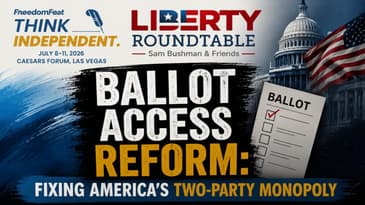
[00:03:59] So essentially right now we have a two party system. Unfortunately, I agree. We have. I personally think the party should be over and the founders warned against parties, but I'm with you in reality. The RNC and the DNC are private corporations. They're criminal private corporations. They're not part of the government. We didn't vote them in. And they essentially currently run our country. And they have greater access to the ballot than you do. And it's criminal. A hundred percent that. And so what I believe, I'm a capitalist. I believe in free markets. Sure. And I believe that competition breeds excellence.
[00:04:29] OK. If it's fair competition, level playing field, I a hundred percent agree. Correct. And so it's manipulated like the Republicans and Democrats have done to where you don't have a place at the table what they do. Then I feel like that's naked capitalism and it's evil and wrong. A hundred percent that. So the goal of our organization is to change the ballot access laws for candidates so that candidates can get on the ballot in all states easily and equally to the Republicans and the Democrats.
[00:04:55] Currently, the Republicans and the Democrats create the rules and the laws that allow you to participate in the system. Yes. And I believe that right now in America, there's vast swaths of people that don't feel represented. They don't feel heard. They're disenfranchised. For sure. You're right. And so and part of that is because they don't have any candidate to vote for because the candidates have been all eliminated essentially from the ballot. And so they play games at primaries. They have close primaries.
[00:05:21] They do all kind of things where everybody really in the end is disenfranchised except for the top few in whatever party we're talking about. Exactly. And so when you feel disenfranchised and you don't feel heard, one of the outcomes is violence. You don't want to punch people. I get it. Right. Not that I think it's acceptable. Right. I do understand the feeling. Yeah. And so we have crafted 50 state legislation to change ballot access laws around the country. And the reason you say 50 state legislation, just so my audience understands, I don't mean to walk you through this like you don't know, but I want my audience to be caught up. Right. It's it's a complicated topic.
[00:05:49] So 50 states because we don't have federal control of elections right now. It's a state controlled issue. And the point why I'm spending time on that is because people are trying to change that and make it a national issue. I want to support what you're doing, but I don't want to make it a national issue either. Yeah, I agree with that. And so that's that. Yes. And that's that's why we are trying to attack it at the state level. Perfect. I love it.
[00:06:10] And so if you go to ballots without barriers dot com, it's an activist platform where you go in, you put in your address and we will send a postcard to your state legislators, letting them know that you want ballot access laws change and you want more competition. On my behalf. On your behalf. And so you're talking about the federal senators or the state house. I love it. Your state house. And then. So wait, when you say state house, are we talking about house reps or senators or both? It's both. It goes to your.
[00:06:35] So the bottom line is whatever state I'm from, I go on to your website, I specify my state and then you guys fire off this if I want you to on my behalf to say, hey, state house, state senate. Get this done. Correct. I love it. Exactly that. And so the thing is, is they wouldn't listen to us because we're not their constituents. But if we get their constituents to say we want these changes in America to make things better. They still won't listen. Your point's well taken, though, that it does matter. Yeah. And they do pay attention more to their constituents. I agree 100 percent. Yeah. I'm just teasing. They really don't. It feels like.
[00:07:05] But they do if we push hard enough and there's enough of us. That's right. And so and so this is the way that we see a path forward. And we've already had success in in Rhode Island and in Maine. We've gotten bills in front of the state houses there. And so and we also were able to get a proportional representation bill in front of the floor in Wyoming. The first time west of the Mississippi for proportional representation. I love it. One of the things about proportion proportional representation is that it fixes gerrymangering. Of course it does. And that's because it's not about party.
[00:07:34] It's not about race. It's not about any fault lines you can draw. It's about we the people. Correct. 100 percent. And my whole goal is to get us closer back to what the founding fathers were all about. What our constitution was all about. Limited government. Without violence of any kind. 100 percent. Of course. Because I believe in the non-aggression principle. Sure. You know especially for. That's because you're half libertarian. Well I actually ran for president as a libertarian in the 2024s. Okay. I love it. I would call myself. I voted independent in the third party my whole life.
[00:08:04] Okay. I've never really felt like either party really represented me. The big parties. Sure. You know I voted for Ross Perot and Ron Paul. I thought Ross Perot was completely right back in the day. Yeah. He's been proven right over and over and over. You can make fun of him for his circles on the board. That are spot on. Ron Paul was right too. And so was Pat Buchanan. And we can keep going with a lot of these people that never had a fair chance. Right. That's right. Neither did you is why I'm bringing this up. Yeah. 100 percent that. And you know when Ross Perot ran and he was able to get in the debates and he got 19 percent of the vote. It was incredible.
[00:08:33] The two party system said we're never allowing that again. And there's never been another third party or independent allowed in the debate stage. And really there's never been anybody that's come close to getting that percentage again. Right. Are you familiar with Christina Tobin? Yes. Of course. Okay. Because she does a great job and she really focused more on the debate side since you brought up debates. Yes. And she does a great job at having free and equal debates and I support her efforts as well. I'm a contributor to her efforts and I was on her debate stage in New York City. So yes, she does great work. Absolutely. I love it.
[00:09:02] So how do people participate then? They go to your website. They do that. Is there dollars involved? No. We're a nonprofit organization. And so we are sponsoring the pamphlets to go out to the state houses. And we pay for that. I'm mostly funding it myself. Whoa. Good for you. What do you do for a living? Well, I am a serial entrepreneur and currently I'm doing late stage venture capital in pre-IPO companies like SpaceX and Anthropic. That big of companies? Yes.
[00:09:31] I like the really big late stage stuff. Okay. It's cured. Well, you have a whole lot more understanding of what you're really putting your dollars in. That's right. And I've done a lot of early stage and angel investing and I just find that the returns are smoother and you can count on them a lot more in the lead stage. So tell me a little bit about liberal versus conservative. I know it's red, blue, whatever. Sure. But I'm asking that because where is your support coming from? Is it really coming across the spectrum like we hope? Yes. We're very much nonpartisan.
[00:09:59] This is really just about creating composition. And when I talk to people on the left or the right, most people in America believe in competition. That's what this country is all about. This country is about- Even liberals believe in that. A hundred percent. You know, the DSA, not so much, but the old school liberals, I think, believe in competition and hard work. And I think that that's what the core of America is. So how many people are involved in your organization then?
[00:10:28] Are we all 50 states wide yet? No. Well, yes, we're working in all 50 states, but we have about 10 full-time-ish people working. And then we have state coordinators and regional coordinators that we've been working on. And we're looking for more people. If people have access to state representatives, they know people, they know how to get legislation in front of people. We would love to talk to people that are passionate about that. And ballots without barriers is where they go? Yes. Ballotswithoutbarriers.com. Okay.
[00:10:55] And then tell me this, how far along is each state legislative push? Does that make sense? Yeah. Like, where do we sit? Obviously, some states are going to take the lead. I'll give you a quick example to make the point in Utah. Yeah. Gold and silver currency took off more in Utah. Utah became kind of the flagship state to roll that out across the country. A dear friend of mine was the one who pushed that legislation. He's an attorney, and he got it done. And gold and silver is actually money in Utah. Okay. Which is awesome. Yes, of course.
[00:11:24] But other states have followed suit since then. Yeah. So I'm looking for flagship states to carry the ball on this one. Yeah. So we have targeted the easier states for us. But really, what we're going for is the states where we have access to the legislator. Because that's really the key piece, is we need somebody that's willing to put the bill forth onto the floor. Or New England seems to be, the whole area of New England seems to be pretty ripe for the picture. And that's shocking kind of, isn't it? Yeah. And it's both, you know, they're mostly blue up there.
[00:11:53] And I commend them, but it's shocking. Yeah. Because we would not think that going in, right? That's right. But then we're also looking at Arizona as an example. We're looking at South Carolina. Georgia is really challenging. We also created a map that shows, it grades all 50 states, one through 50, on their level of ballot access and how bad they are. And like A, B, C, D, E, F? A hundred percent that. Yeah. Okay. And how many get A's? Anybody? Two get A's.
[00:12:23] Alaska and Tennessee, I want to say. Wow. Yeah. All right. And, but the rest are all, you know, bad. Texas, California, and New York are among the worst culprits that there is. And do they get an F? They definitely get an F. There's a lot of F's. I went to the Secretary of State. So we're honest all the way through. We don't protect anybody. I love it. I went to the Secretary of State convention where all the Secretary of States gathered. Yeah. And we showed them our map. And most of them thought they were A's. And when we showed them that they were C's, they said, how do we get to be an A?
[00:12:52] And we explained to them. And they thought that was great. And then there were certain states who said, we know we're an F. We like that we're an F. Our party is winning. Oh, whoa. We don't ever want to change it. Don't bother even coming to our state. And I'll name one state that was very specific about that. I want you to name more than one. Well, Illinois was the chief among them. All right. I bet you I can predict a couple of them. Okay. Go ahead. I bet it's New York. Yes. I bet it's Colorado. I bet it's Washington State. Yes. Those are all parts of the things.
[00:13:20] And so the, and so, but then there was other, and what I, what I found was some secretaries of state were using this because they felt like it was their duty to protect voters and to have voting rights. And then there was other secretaries of state who were using it as a political pathway. Like a wedge. It's their stepping stone to their next, you know, position. Right? Yeah. Which is a shame. And so they didn't care. They wanted to protect the party. And so they were like, whatever, whatever grifting we're doing is working good for us.
[00:13:48] Well, George Washington warned us about parties for these very reasons. Yes. What you get is these factions that pull the labor of government in the favor of the few at the expense of the many. And we're seeing this at an alarming, increasing rate in America today. Right? A hundred. Well, I mean, the rise of the DSA with five house members coming on board. Right. That's going to completely change Congress in the next 10 years. I mean, since we're a constitutional republic, not a democratic socialist association, whatever kind they want to call it. That's the deal. Right? Yeah. A hundred percent. All right.
[00:14:18] So how do people help then if they can go to their, obviously you want people to go to their, um, to your website and designate, Hey, send, uh, messages on my behalf to my state legislature. Yeah. Secondly, you want people to become leaders to, um, lead states in what chapters? Yeah. What's the words? I'm using. I think for you, we'd love to have you help us because we need on the ground people that
[00:14:43] know, you know, it's, it's people in states don't want to have random people coming in from other states. A local to lock in and say, Hey, Hey, well, we want to do this. That's right. Are you familiar with Braver Angels? Yes. What do you think of those guys? Um, I've just heard of the name. So, okay. Braver Angels has a goal of bringing red and blue together and saying, it's not about party. It's about a fair, uh, no violence dialogue. Yes. You know what? We don't need to rage and get in a fight.
[00:15:10] We can agree to disagree, but what they try to do is remove the politics and things and humanize people. Yeah. Because if I learn about you, Lars, and I learned that you're a human, whether I agree or disagree, I can at least say, you know what? He's up in the night politically. He's crazy. But I think he's a nice guy. Yeah. Or I think he's a respectable person. Or I think his, I don't agree with those thoughts, but they're well-reasoned or whatever I think. But we, we get past that label stuff. Yeah. That's what Braver Angels does. If I would do a Braver Angels conference, that's why I'm telling you this.
[00:15:38] And they had tags, red tags, blue tags. Then they had yellow tags, which are, um, third party or you're not red or blue, but you'll tell everybody that you're not. Yeah. So that's what I put on is yellow. Okay. And then there's white, which means I'm not going to tell you what I am. Okay. All right. So they had that and it was an interesting experiment. The reason I blew it up is because I first put on a blue tag. Okay. I'm not blue at all. I'm conservative as I'll get out. I mean, I, I, I don't believe myself left or right. I walk straight down the constitutional lane. Yeah. If it's constitutional, I like it. If it's not, I hate it. Okay.
[00:16:08] This makes sense. Non-violence hate, by the way. I just, I don't like, I'm against it. Don't get any arguments out of me. Okay. So, but, so I first put on a blue one and I did it for an experiment because I wanted to see how people would treat me. Yeah. Yeah. Buddy, all the reds treated me as the enemy. So then I took it out and put on a blue or a yellow one. Yes. And then people started to respect me. So it was really weird. It was weird. You're familiar with Dr. Seuss's star belly snitches. This is a hundred, this is a hundred percent star belly snitches. That's right. The blues on the ours and the reds on the ours.
[00:16:36] And you know, you're like, let's take off all the labels. That's right. Uh, my, I remember asking my grandma, uh, well, who did you vote for in the, in the, in the Reagan election? And she told me it's none of your business. And I thought, well, that's weird. I said, grandma, it's just me and you. You can tell me who we, you know, do whatever. And she said, no, we don't talk about that. And I think in most people, if you don't talk about politics, we'd all get along. Yes. But I also think that like bravery angels talks about, we need to learn to talk about politics. That's the brilliance of the nation.
[00:17:05] We just need to learn how to do so in a civil way. We need to learn to do so in a way that we can disagree. Yeah. Agreeably. Yeah. Okay. It's okay. If we disagree, that doesn't mean we're enemies. We're still fellow Americans. We still want the same things. We might not agree on everything, but we want, I mean, we all want to be basically, well, just take the redneck creed of the 10 commandments. Yeah. Hey man, don't hurt me. Don't take my stuff. Just leave me alone. You know? Yeah. Yeah. And we all want that, don't we? Yeah.
[00:17:32] I think social media has, you know, made it really difficult for that. If you and I are sitting around with a group of people, we can all, you know, agree to disagree and not kill each other. But when you have the anonymity of social media, you can just yell with impunity at other people. And I think that's one of the big problems that we're having right now. It's true. It's a sad commentary, but I believe we can fix it. I believe organizations like yours can fix it because there's so much anger and vitriol and division about ballots. Yeah.
[00:18:02] And you're just simply saying, Hey folks, ballots without barriers.com. Let's fix that. Let's let everybody get on the ballot. Let's let real debates happen. Let's let the real Creighton rise to the top. Right? Yeah. Yeah, absolutely. Yeah. Fair competition breeds excellence. What have I left out? Anything? No, I think that's it. We're in, we obviously we're a nonprofit, so we're accepting donations. Uh, you know, people believe in what we're doing. Yeah. So tell people to start with a number one and then add zero. That's right. A hundred percent. All right.
[00:18:31] I appreciate it, sir. You know what? Lars, we really appreciate what you're doing though. I think what you're doing is needed in America today. I think it has validity. I hope we can partner your organization with as many other organizations as we can to get the word out because I believe that it's the key to the exercise. And if we do it right, it prevents elections from being nationalized. I know there's a big quest for that because they think that it'll simplify things. They're wrong though. All the feds will do is ruin it. But your plan, in my opinion, really preserves the election process. Yes. Last question. What about vote fraud?
[00:19:00] Do you guys get involved in that at all? We don't get involved in vote fraud. I believe that there is vote fraud. I don't know if there's enough vote fraud to really shift it in across the country, but in certain areas of the country, I think there's definitely vote fraud. I mean, it's pretty obvious. People running around with boxes of ballots on video. It's pretty obvious. Like, you know, in my town, it's a student town and houses will have 20 different ballots show up at the house because there's been all these students living in the house. Not early vote off. Right.
[00:19:27] And then, you know, all the kids have gone off to back home for the summer break or whatever it is. And then, you know, one guy votes the 12 things. Of course that happens. I mean, of course it does. Right. So, but is it enough to completely sway a national election? I'm not sure. But not a national election. And that's my problem. Because again, what we do is we have this problem. And rather than addressing the problem locally, so at the precinct level and or at the state level like you're doing. Yeah. We want to nationalize this, nationalize that. And pretty soon we think, oh man, the national is the problem.
[00:19:56] It's been co-opted. Now we've got to create more laws and more like pretty soon, man, instead of the take your advantage, you got the 10 gazillion and we're begging for more. Yeah. And really what we need to do is back government out of it. Have people be involved and make sure that people have less access to pull the lever in their favor. Yeah. We just need more transparency, I think, also in our elections. And accountability. People got to go to jail when they're bad actors. That's right. A hundred percent. Bad actor. I agree. All right. Give your name and your website one more time. Lars Mapstead. BallotsWithoutBarriers.com. I'm Sam Bushman for Liberty Roundtable Live.
[00:20:26] God save our constitutional republic. Amen.